Tungsten sits within a few hundredths of gold on the density scale, which is why a perfect density reading proves nothing about a bar.
Pure gold is about 19.3 g/cm³ and tungsten about 19.25, a gap too small for shop-class instruments to resolve reliably. That coincidence is the reason tungsten-filled bars are the best-known fraud in bullion. This guide lays out the numbers, explains how real and fake bars can match in density, shows what different alloys do to the picture, and names the second checks that actually separate them.
- Gold is about 19.3 g/cm³ and tungsten about 19.25; a bench densimeter cannot reliably separate them on density alone.
- Gold-plated tungsten of the right size can produce a bar-weight and density match that looks perfect.
- Ultrasonic testing, conductivity, XRF depth checks, and assay are the methods that separate gold from tungsten.
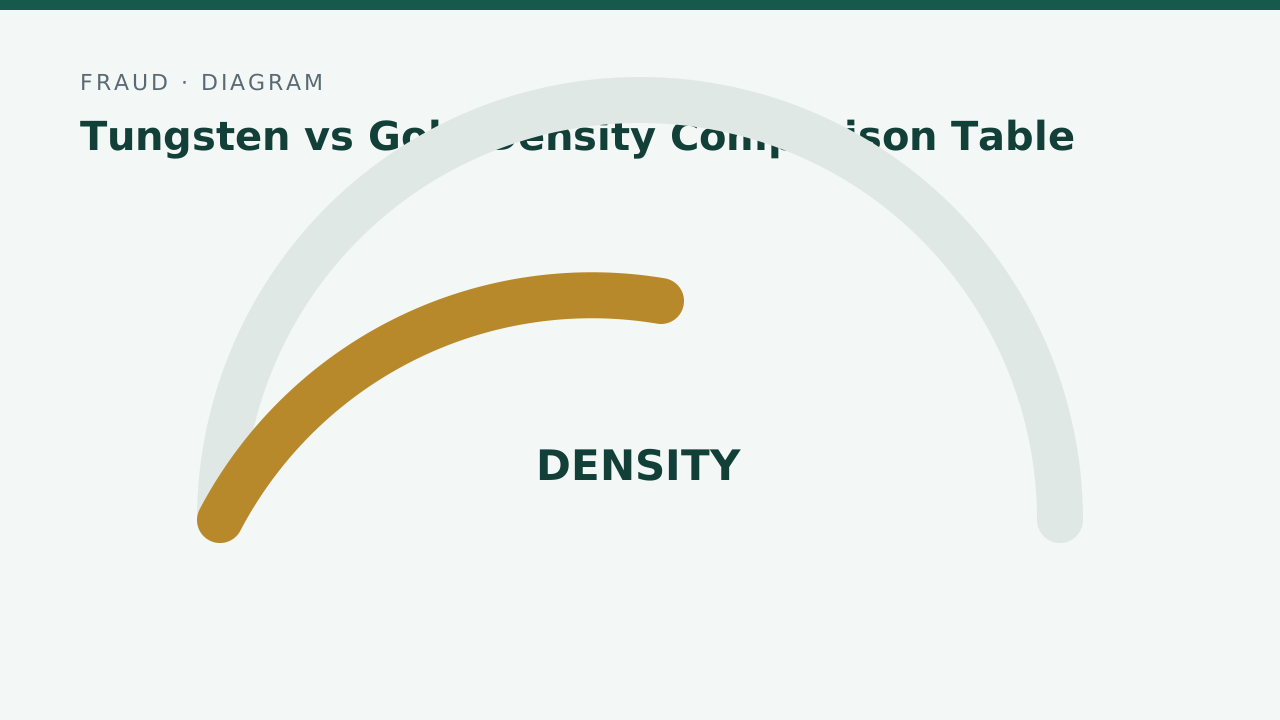
Respect the overlap
A density match is not a pass when the suspect metal is tungsten.
Check dimensions
A bar that weighs right but is slightly oversized or undersized for its mass is a clue.
Second method required
Use ultrasonic, conductivity, XRF depth, or assay for high-value bars.
Escalation rule
Write down the value above which bars never clear on density alone.
The numbers and why they collide
Gold at 24K measures about 19.3 g/cm³. Tungsten measures about 19.25 g/cm³ in typical references, a difference of well under one percent. A densimeter reading of 19.25 to 19.35 on a bar could therefore be gold, tungsten, or something in between. Bench instruments have a resolution of 0.001 g/cm³ in their display, but real accuracy is limited by weighing error, bubbles, temperature, and the size of the sample. For a 1 oz bar the weighing noise alone can exceed the difference between the two metals.
Other details add to the problem. Gold alloyed with copper or silver reads lower than 19.3, so only fine-gold bars live near the overlap. A fraudster can therefore build a bar with a tungsten core and a gold skin that has the right outer weight and dimensions. Tungsten carbide, used in industrial tools, has a different density near 15, so it reads low, but pure tungsten is the real worry. The practical lesson is that density is a screen for hollow, plated, or lead-filled goods, not a proof of purity in bars.
Checks that separate them in practice
Ultrasonic thickness testing is one of the strongest methods because sound travels differently through gold and tungsten, and it can detect internal layers or voids without damaging the bar. Electrical conductivity helps too: gold conducts roughly twice as well as tungsten, so a good eddy-current probe sees a clear difference near the surface, though thick gold plating can mask it. XRF verifies surface composition and is useful for bars with thin coatings, but the signal is shallow, so it works best combined with another method.
Dimensional checks are free. A tungsten bar of the same weight as gold has almost identical volume, so a precise caliper rarely catches it, but any mismatch from the mint's published dimensions is a red flag. Sound or ring tests, magnetism tests, and visual inspection of edges and serial numbers add additional clues. For high-value bars, the safest approach is to drill or section a sample, or to send the bar to a laboratory for assay. Document the chain of checks you used on each bar for later review.
- Never clear a bar on density alone above your threshold.
- Combine at least two independent methods for bars.
- Keep mint dimensions and weights for common bars on file.
Density comparison table
Use the table below to brief staff on why tungsten is the exceptional case, and keep it with the escalation policy for bars. Notice how every other common substitute sits far from gold and is caught easily by density, while tungsten alone sits almost on top of it.
| Metal | Approx density (g/cm³) | Densimeter separates from gold? |
|---|---|---|
| Gold (24K) | ~19.3 | Reference |
| Tungsten | ~19.25 | No, overlap |
| Platinum | ~21.45 | Yes |
| Lead | ~11.3 | Yes |
| Silver | ~10.5 | Yes |
| Copper | ~8.96 | Yes |
| Tungsten carbide | ~15.6 | Yes, reads low |
Recommended densimeters for this workflow
| Product | Best for | Price tier | Editor view | Amazon |
|---|---|---|---|---|
| MDJ-1200K class Gold Densimeter (1200 g) | Coin desks and buyers who see heavy chains or small bars | Value | Editor assessment: Strong | Check Latest Price → |
| Alfa Mirage GKS-300 | Mixed gold + platinum desks that need finer purity readouts | Premium | Editor assessment: Strong | Check Latest Price → |
Best for Heavy Chains & Coin Desks
MDJ-1200K class Gold Densimeter (1200 g)
- Best forCoin desks and buyers who see heavy chains or small bars
- Price tierValue
- Editor viewEditor assessment: Strong
Best for Platinum / Finer Purity
Alfa Mirage GKS-300
- Best forMixed gold + platinum desks that need finer purity readouts
- Price tierPremium
- Editor viewEditor assessment: Strong
Best for Heavy Chains & Coin Desks
MDJ-1200K class Gold Densimeter (1200 g)

Key takeaways
- 1200 g headroom for heavy chains and small bars
- First-pass tool—not a tungsten-bar closer
- Check tank clearance photos before you buy
Coin desks and buyers who see heavy chains or small bars
Everything you buy is under ~200 g
Quick snapshot
Pros
- 1200 g headroom for heavy solid pieces
- Shop-class 0.001 density resolution
- Common Amazon option for bullion-adjacent buyers
- Often printer-ready for intake records
Cons
- Bulkier and unnecessary for light jewelry-only shops
- Tank clearance can still fail large flat coins—check photos
- Density will not catch every tungsten-filled bar
- Generic branding; verify seller and accessories
Why we picked it
Why it earns the badge
We recommend the MDJ-1200K class when capacity—not brand prestige—is the bottleneck. Coin desks and heavy-chain buyers outgrow 600 g more often than they outgrow 0.001 density resolution. This pick is about headroom and daily workflow: weigh heavy solid pieces without maxing the load cell, run a shop-class density/purity screen, and keep a first-pass number on the ticket before you escalate expensive lots.
Who it is ideal for
Ideal for coin and bullion-adjacent desks, pawn overflow days with thick solid chains, and buyers who occasionally see small bars or stacked solid scrap that would crush a 300 g jewelry densimeter. Many listings in this class also mention printer compatibility, which helps managers who want a paper trail of the screen during customer disputes—as long as everyone understands a slip is not a fire assay certificate.
Who should skip it
Skip it if your solid jewelry stays light (rings and small bracelets under ~200 g). You will park a larger footprint on the counter for no operational gain, and a 300 g premium jewelry unit or a clean 600 g kit will feel less intrusive. Also skip densimetry alone if your main fear is tungsten-filled bars; density of tungsten is too close to high-karat gold for Archimedes to be the closing argument. Write an XRF or assay threshold for those tickets before the machine arrives.
What real buyers get wrong
Tank geometry still matters at 1200 g. Large flat coins or oddly shaped pieces can fail clearance even when the weight is within capacity—check listing photos of the tank and hanger, not just the gram number. Low-star themes in heavy-capacity Amazon densimeter kits mirror the rest of the category: missing accessories, confusing multi-capacity titles, and buyers who expected densimetry to replace every other authenticity tool. Buy the 1200 g class for headroom, confirm the SKU, train solid-sample discipline, and escalate high tickets. That is how coin desks get value from this machine without overclaiming what density can prove.
Key specs → desk benefits
1200 g capacity
Handles heavy solid chains and many small bars without maxing the load cell.
0.001 g/cm³ density display
Gives coin desks a repeatable first-pass number before escalating expensive pieces.
Best for Platinum / Finer Purity
Alfa Mirage GKS-300
Key takeaways
- Upgrade for platinum + finer purity—not more capacity
- Ideal after staff already know air/water workflow
- Wrong pick if heavy chains are the real bottleneck
Mixed gold + platinum desks that need finer purity readouts
You only need basic 10K/14K banding or need >300 g capacity
Quick snapshot
Pros
- Finer weighing supports tighter purity display than base GK-300
- Platinum tables help mixed precious-metal counters
- Lower minimum sample weight on the GKS class
- Same non-destructive solid-metal workflow jewelers already trust
Cons
- Same 300 g ceiling—no capacity upgrade over GK-300
- Costs more; overkill if you only screen broad karat bands
- Still blind on hollow / gem-set constructions
- Buyers who needed grams of capacity sometimes regret not buying 600 g instead
Why we picked it
Why it earns the badge
The GKS-300 is our pick when a jewelry desk already understands densimetry and needs finer purity—especially with platinum in the mix. Paying more for another 300 g machine only makes sense if resolution and metal tables are the bottleneck, not capacity. The GKS class is aimed at buyers who already trust the air/water workflow and want a tighter purity display plus platinum tables so mixed precious desks do not bounce between instruments mid-intake.
Who it is ideal for
Ideal buyer: estate jewelry shops, mixed gold/platinum buyers, counters that quote tighter purity on solid lots, and managers who already trained staff on solid-sample rules. If your real pain is heavy chains or small bars, this is the wrong upgrade path. Buying finer decimals on a 300 g load cell will not fix “piece won’t fit” days. Move to 600 g or 1200 g capacity first, then revisit finer resolution only if disputed near-pure lots justify it.
Who should skip it
Skip it if you are budget-first, still learning the air/water workflow, or only need broad 10K/14K banding for scrap payouts. In those cases the base GK-300—or a clear 600 g value kit—delivers more practical upside per dollar. Also skip it if you mainly handle gem-set fashion jewelry; finer resolution does not fix the mixed-density problem of stones and hollow links.
What real buyers get wrong
Honest buyer sentiment in this category often sounds like disappointment about capacity, not about the decimal places. Reviewers who needed grams of headroom regret spending premium money on another 300 g footprint. Others expect densimetry to settle tungsten-bar disputes and walk away frustrated—density of tungsten is too close to high-karat gold for Archimedes alone. Use the GKS-300 as a sharper first-pass tool for solid gold and platinum desk work, pair high tickets with XRF or assay policy, and you get the upgrade you paid for instead of a more expensive version of the wrong problem.
Key specs → desk benefits
0.001 g weight resolution / finer density class
Helps when you are comparing near-pure pieces or platinum marks where coarse banding feels sloppy.
Gold + platinum purity tables
One bench tool covers more of a mixed precious desk without switching instruments mid-intake.
Buying decision
Remember a densimeter is a first-pass screen for bars; confirm capacity on the live listing.
FAQ
Can a densimeter detect tungsten in gold bars?
Not reliably. Tungsten and gold differ by less than one percent in density, which is inside the practical error of bench instruments. Use ultrasonic, XRF, conductivity, or assay.
Does a bar that reads 19.3 mean it is real gold?
No. It means the bulk density is consistent with gold, but a tungsten-filled bar can produce the same number.
Which test is best for bars?
Ultrasonic testing combined with XRF or conductivity is common in shops, while assay remains the definitive check for high-value bars.