Gold-filled jewelry is real gold, in a layer, over brass, and a densimeter will not mistake it for a solid piece.
Estate and vintage buyers regularly meet pieces marked GF, 1/20 12K, RGP, or HGE and must explain to sellers what they actually contain. Gold-filled is thicker than plating but still only a few percent of the mass. The density result lands near brass, and that single number tells you what to pay and what to decline.
- A standard 1/20 12K gold-filled piece contains about 5 percent 12K gold by weight, or roughly 2.5 percent fine gold overall.
- Bulk density comes out near 8.6 to 9.5 g/cm³, essentially the brass or copper core.
- Terms like rolled gold plate and heavy gold electroplate describe thinner layers than true gold-filled.
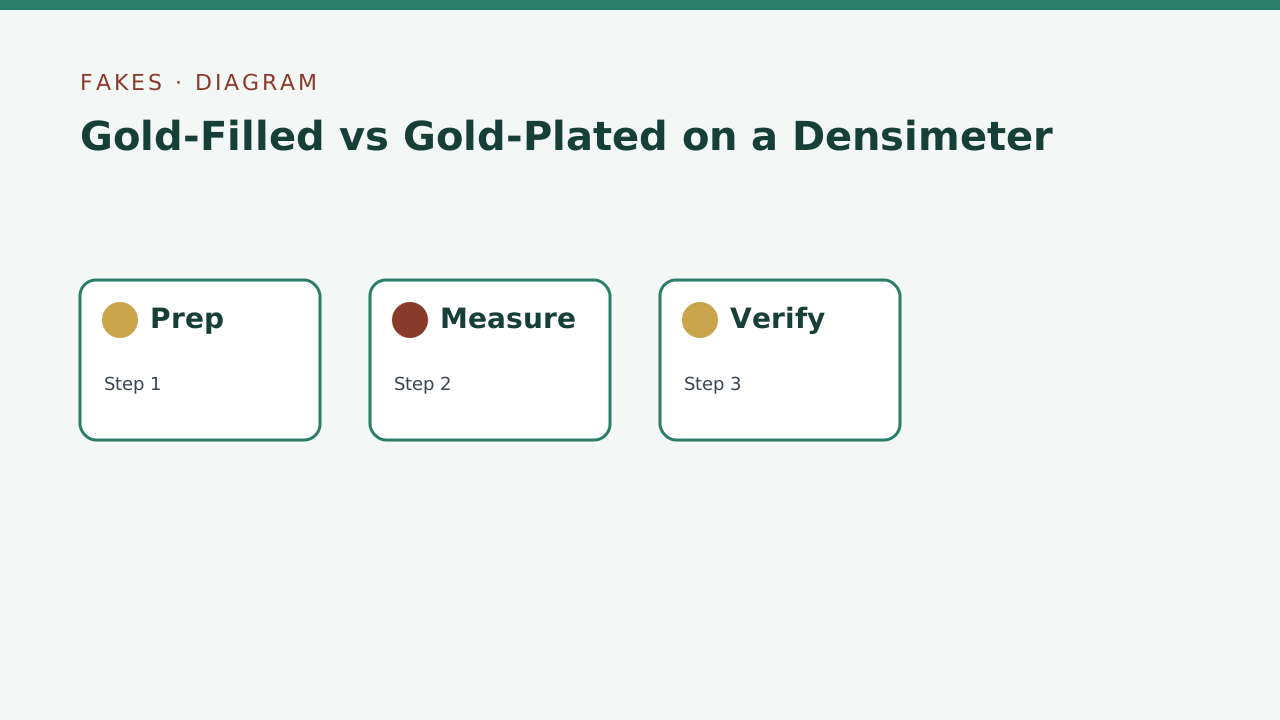
Read the hallmark
GF, 1/20 12K, RGP, and HGE mean different layer thicknesses.
Bulk-density result
Expect a reading near brass; it will not fit any solid karat band.
Recoverable gold math
Compute fine gold content from the layer fraction before quoting scrap value.
Seller explanation
Frame it as a real-gold layer with limited value, not a fake.
What the marks mean and how much gold there is
Gold-filled jewelry is made by bonding a layer of karat gold to a base metal, usually brass, under heat and pressure. The common US convention is that the gold layer must be at least 1/20 of the total weight. A piece marked 1/20 12K GF has a layer that is 5 percent of the weight, and that layer is 12K, meaning 50 percent gold. The result is about 2.5 percent fine gold by weight, so a 10 g chain holds roughly 0.25 g of pure gold.
Rolled gold plate, RGP, uses a thinner layer, often 1/40 or less, and heavy gold electroplate or HGE is an electroplated layer of at least about 2.5 microns. These are weaker still. Vintage marks such as 'gold filled' without a fraction are common, and quality is variable. None of these should be confused with solid gold, and none should be priced like it. They are, however, real gold in a thin layer, which is a useful way to explain the value to a seller who feels cheated.
- GF with fraction: 5% layer typical for 1/20
- RGP: thinner, often 1/40 or less
- HGE: electroplate, not bonded
Why the densimeter reads like brass
Compute the bulk density of a 1/20 12K piece. The gold layer is 5 percent of the weight at about 13 g/cm³ for 12K, and the brass core is 95 percent of the weight at about 8.5. The combined volume per gram is 0.05 divided by 13 plus 0.95 divided by 8.5, or 0.1157 cm³, which gives a bulk density near 8.64. A copper core pushes it to about 8.9, and a sterling core would lift it to roughly 10.3.
In every case the reading lands below the 10K floor. The densimeter does not need to know about layers; it sees an object that displaces a lot of water for its mass. In karat mode the machine may show an out-of-range message or a meaningless number like 6K. That is the correct result for a gold-filled piece when you are asking whether it is solid gold. For payout, estimate recoverable gold from the layer fraction and the refinery's practical return.
Gold-filled, rolled gold, plated, and solid compared
Use this table when a seller insists their piece 'is 12K'. The mark may be literally accurate for the layer but misleading about the object. Offer the seller a comparison: a solid 12K piece at this weight would contain about 50 percent gold, while a gold-filled piece at the same weight contains about 2.5 percent. Many refiners decline GF items entirely because recovery costs exceed the gold value, so treat any payout as a courtesy rather than a market rate.
| Type | Gold layer | Fine gold in a 10 g piece | Typical density (g/cm³) |
|---|---|---|---|
| Solid 12K | Entire piece | About 5 g | 12.2 to 12.8 |
| 1/20 12K gold-filled | About 5% by weight | About 0.25 g | 8.6 to 9.5 |
| 1/40 rolled gold plate | About 2.5% by weight | About 0.1 g | 8.5 to 9.0 |
| Gold electroplate | Under 0.01% by weight | Under 0.001 g | 8.4 to 8.9 |
Recommended densimeters for this workflow
| Product | Best for | Price tier | Editor view | Amazon |
|---|---|---|---|---|
| Alfa Mirage GK-300 | Jewelry counters buying solid gold under ~250 g | Premium | Editor assessment: Excellent | Check Latest Price → |
| Alfa Mirage GKS-300 | Mixed gold + platinum desks that need finer purity readouts | Premium | Editor assessment: Strong | Check Latest Price → |
Best Overall for Jewelry Desks
Alfa Mirage GK-300
- Best forJewelry counters buying solid gold under ~250 g
- Price tierPremium
- Editor viewEditor assessment: Excellent
Best for Platinum / Finer Purity
Alfa Mirage GKS-300
- Best forMixed gold + platinum desks that need finer purity readouts
- Price tierPremium
- Editor viewEditor assessment: Strong
Best Overall for Jewelry Desks
Alfa Mirage GK-300
Key takeaways
- Best when solid jewelry stays under ~250 g
- Karat language staff can explain to customers
- Skip if heavy chains already crowd 300 g
Jewelry counters buying solid gold under ~250 g
You regularly buy heavy chains or bars over 300 g
Quick snapshot
Pros
- Karat modes built for gold buying—not a generic lab densimeter UI
- Japan-made brand that shop owners recognize for warranty optics
- Doubles as a gram scale so trade-ins stay on one footprint
- Non-destructive first pass—no acid stains on retail-ready pieces
Cons
- 300 g ceiling fails many pawn-weight solid chains
- Premium price vs generic 600 g Amazon kits
- Still cannot test hollow or gem-set jewelry (physics limit)
- Some buyers complain about learning the water-hang workflow on day one
Why we picked it
Why it earns the badge
We picked the Alfa Mirage GK-300 as the best overall starter for jewelry stores because it is built around karat language, not just a bare density number. On a retail counter, that matters more than most buyers admit on day one. A salesperson can take a solid trade-in, run the air weight and water weight, and talk in K14 / K18 terms the customer already understands—without translating a raw density chart mid-conversation. The Japan-made positioning also helps when an owner asks why you are not buying the cheapest no-name kit on Amazon. Warranty optics and brand familiarity reduce pushback from partners who have seen too many generic electronics fail after a few busy seasons.
Who it is ideal for
This machine is ideal if your solid intake mostly stays under about 250 g: rings, solid bracelets, light scrap lots, and estate pieces that are clearly solid metal. Treat the 300 g ceiling as a hard workflow limit, not a marketing number. If your desk routinely sees thick Cuban chains, stacked scrap bags, or solid pieces that regularly flirt with 280–300 g, capacity—not brand prestige—should win, and you should move to a 600 g shop densimeter before you outgrow the GK-300 mid-purchase.
Who should skip it
Who should skip it: pawn shops with heavy-chain days, coin desks handling bars, budget-first buyers who only need a rough karat band once a week, and anyone who thinks a densimeter will replace acid or XRF for hollow or gem-set goods. Manufacturer guidance is blunt on the physics limits: hollow jewelry, stone-set pieces, and metals with density very close to gold (including tungsten cores in bars) are outside the trustworthy zone. Those are not “bugs” in the GK-300—they are limits of Archimedes testing itself.
What real buyers get wrong
When you dig past star ratings on Amazon-style densimeter listings, the recurring 1-to-3 star themes are rarely “karat mode is fake.” They are operator and expectation problems: air bubbles clinging to textured scrap, the sample touching the tank wall, testing hollow electroformed jewelry that returns falsely low density, missing English manuals on generic kits, and buyers who expected an assay certificate instead of a first-pass screen. Train solid-sample rules on day one, keep distilled water and a soft brush at the tank, and use a written threshold for when density results escalate to XRF. Done that way, the GK-300 becomes a reliable buyer aid on a jewelry desk rather than a mysterious black box that staff avoid after one awkward customer conversation.
Key specs → desk benefits
300 g capacity / 0.01 g weight resolution
Stable enough for solid rings and most bracelets, with gram-scale precision that keeps scrap payouts honest.
K9–K24 karat + purity % modes
Staff can explain a karat band to a customer in one sentence instead of translating raw density charts.
Densimeter + scale in one unit
You avoid buying a separate jewelry scale for intake weighing on the same counter.
Best for Platinum / Finer Purity
Alfa Mirage GKS-300
Key takeaways
- Upgrade for platinum + finer purity—not more capacity
- Ideal after staff already know air/water workflow
- Wrong pick if heavy chains are the real bottleneck
Mixed gold + platinum desks that need finer purity readouts
You only need basic 10K/14K banding or need >300 g capacity
Quick snapshot
Pros
- Finer weighing supports tighter purity display than base GK-300
- Platinum tables help mixed precious-metal counters
- Lower minimum sample weight on the GKS class
- Same non-destructive solid-metal workflow jewelers already trust
Cons
- Same 300 g ceiling—no capacity upgrade over GK-300
- Costs more; overkill if you only screen broad karat bands
- Still blind on hollow / gem-set constructions
- Buyers who needed grams of capacity sometimes regret not buying 600 g instead
Why we picked it
Why it earns the badge
The GKS-300 is our pick when a jewelry desk already understands densimetry and needs finer purity—especially with platinum in the mix. Paying more for another 300 g machine only makes sense if resolution and metal tables are the bottleneck, not capacity. The GKS class is aimed at buyers who already trust the air/water workflow and want a tighter purity display plus platinum tables so mixed precious desks do not bounce between instruments mid-intake.
Who it is ideal for
Ideal buyer: estate jewelry shops, mixed gold/platinum buyers, counters that quote tighter purity on solid lots, and managers who already trained staff on solid-sample rules. If your real pain is heavy chains or small bars, this is the wrong upgrade path. Buying finer decimals on a 300 g load cell will not fix “piece won’t fit” days. Move to 600 g or 1200 g capacity first, then revisit finer resolution only if disputed near-pure lots justify it.
Who should skip it
Skip it if you are budget-first, still learning the air/water workflow, or only need broad 10K/14K banding for scrap payouts. In those cases the base GK-300—or a clear 600 g value kit—delivers more practical upside per dollar. Also skip it if you mainly handle gem-set fashion jewelry; finer resolution does not fix the mixed-density problem of stones and hollow links.
What real buyers get wrong
Honest buyer sentiment in this category often sounds like disappointment about capacity, not about the decimal places. Reviewers who needed grams of headroom regret spending premium money on another 300 g footprint. Others expect densimetry to settle tungsten-bar disputes and walk away frustrated—density of tungsten is too close to high-karat gold for Archimedes alone. Use the GKS-300 as a sharper first-pass tool for solid gold and platinum desk work, pair high tickets with XRF or assay policy, and you get the upgrade you paid for instead of a more expensive version of the wrong problem.
Key specs → desk benefits
0.001 g weight resolution / finer density class
Helps when you are comparing near-pure pieces or platinum marks where coarse banding feels sloppy.
Gold + platinum purity tables
One bench tool covers more of a mixed precious desk without switching instruments mid-intake.
Buying decision
A karat-mode densimeter on an estate counter turns 'is it real?' into a clear measurement that sellers can understand.
FAQ
Is gold-filled real gold?
Yes, there is a layer of real karat gold bonded to a base metal, but it makes up only a few percent of the weight.
Will a densimeter ever pass gold-filled as solid?
No. Gold-filled reads near the base metal's density, well below any solid-karat band.
Can gold-filled jewelry be sold for scrap?
Usually for little. The recoverable fine gold is small and many refiners will not process it, so treat any offer as modest.