Weighing a whole bag at once is fast, but the average hides exactly the item that costs you money.
This is for scrap buyers who want to speed up intake by testing solid lots together. Batch densimetry works only under strict conditions, and a mixed-karat or mixed-metal bag can produce an average that looks sensible while misrepresenting the gold content. We show the math, give lot rules, and flag where to stop averaging and test items one by one.
- Lot density is total mass divided by total volume, so heavier pieces dominate the mass but low-density pieces dominate the volume.
- A bag of 100 g 18K plus 100 g sterling silver reads about 12.4 g/cm³, while its gold content is only about 37.5 percent.
- Batch testing is acceptable only for same-karat, solid, clean lots.
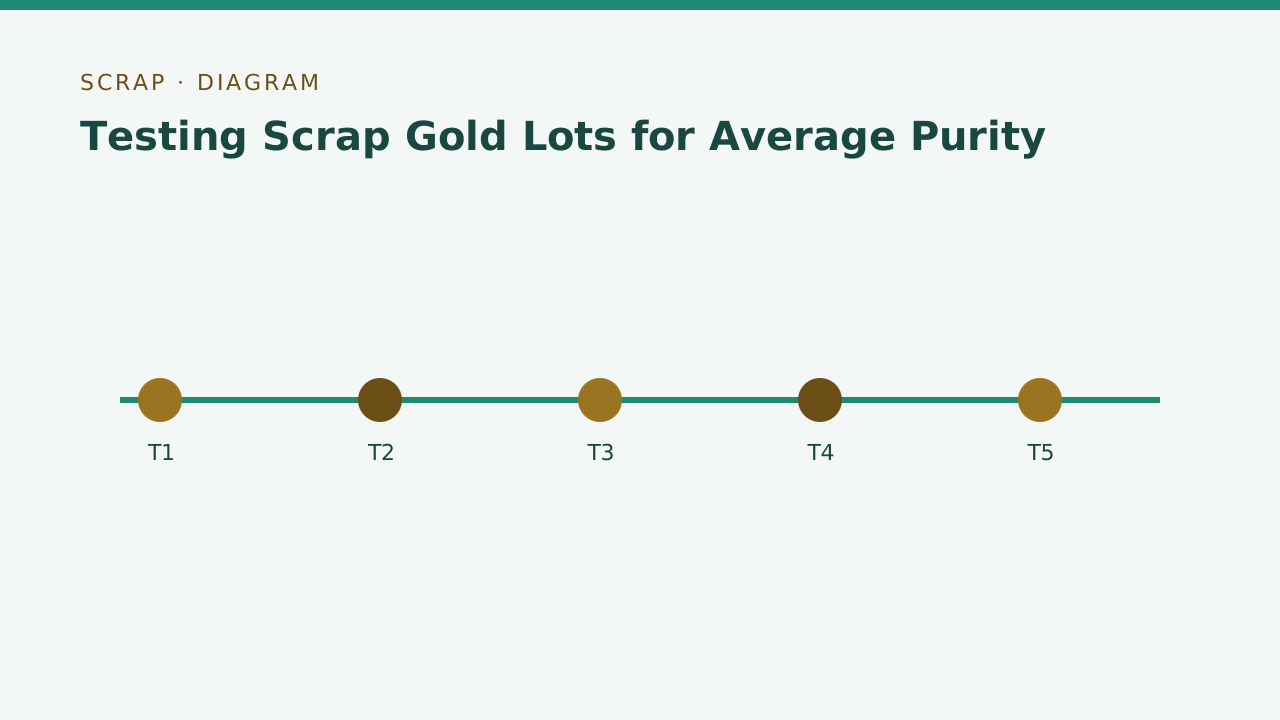
Homogeneous lots
Only batch items that claim the same karat and are all solid.
Volume-weighted math
Remember the average is by volume, so a bulky low-density item skews it more than its weight suggests.
Capacity and tank fit
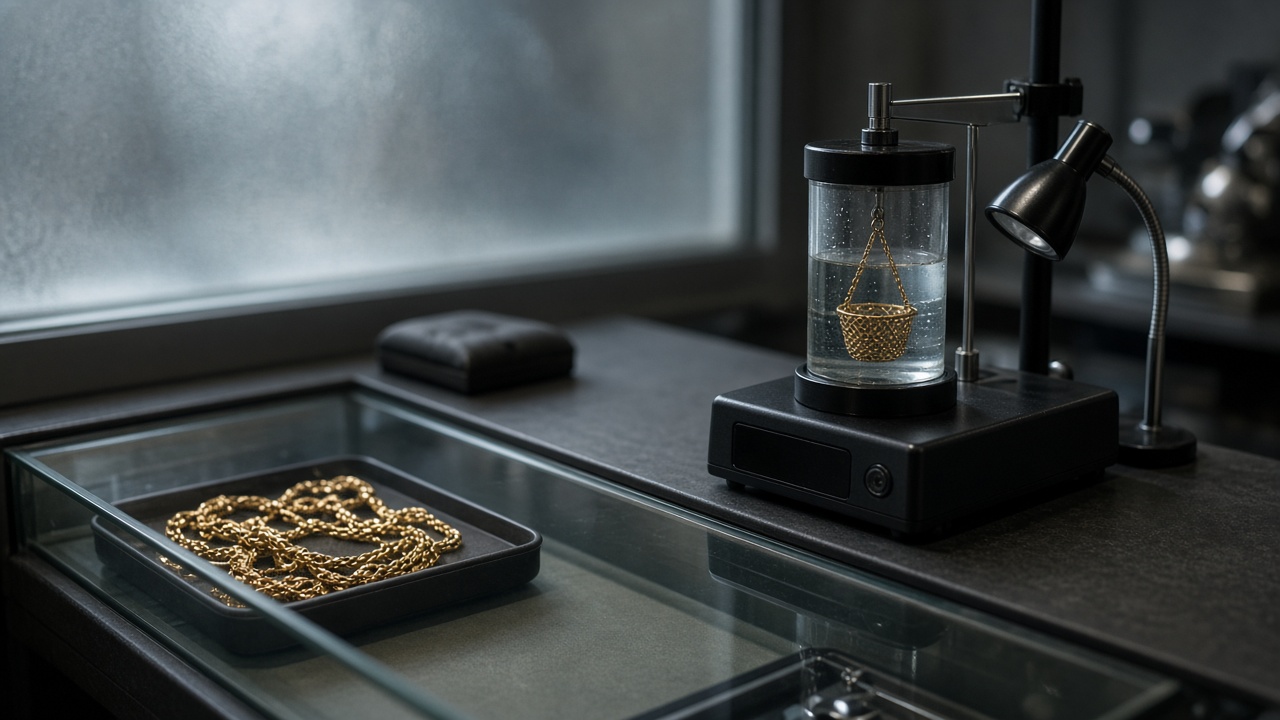
A basket full of loose scrap needs the capacity and the clearance to avoid wall contact.
Spot-check sampling
Back batch results with individual tests on the biggest pieces.
What a lot density really tells you
When you drop a mixed bag in the basket, the machine measures total mass and total displaced volume. The density it reports is mass divided by volume, not the average of individual densities. A heavy piece of 18K takes less volume than a light piece of equal weight in 10K, so each item contributes in proportion to its volume. This sounds like a detail but it changes how you read the result. Think of it as a fair measure of the whole bag and a poor measure of any individual item in it.
If every piece in the bag is the same karat and solid, the lot density is simply that karat's density and a batch test is a legitimate time-saver. If the pieces vary, the number is a blend that may correspond to a karat nobody in the bag actually has. The machine cannot know. It will happily display a clean 14K reading for a bag that contains some 10K, some 18K, and some brass, and that is a real hazard to your margin.
- Same karat, solid, clean: batch testing works
- Mixed karat: average may land on a karat that does not exist in the bag
- Mixed metals: the reading can mask a large non-gold fraction
A mixed-bag example that fools the screen
Take 100 g of 18K at 15.4 g/cm³ and 100 g of sterling silver at 10.4. The combined volume is 6.49 cm³ plus 9.62 cm³, which is 16.11 cm³. The lot density is 200 divided by 16.11, or about 12.4 g/cm³, and the screen reads about 12K. Meanwhile the actual gold content is 75 g in 200 g, or 37.5 percent, which is closer to 9K. A buyer paying on the displayed karat would overpay by about a third. The same trap applies to any bag where a lighter non-gold item rides along with gold, because its large volume pulls the density down while adding almost no value.
A subtler problem is a bag of 10K and 18K mixed together. Their blended density can land close to 14K and, interestingly, the gold content also lands near 14K, so the average might be roughly right by luck. Do not build policy around luck. Use batch testing for homogeneous lots only, and treat anything mixed as a sorting job first and a testing job second. Add a column to your intake sheet for 'lot homogeneous: yes or no' so the decision to batch is recorded before the machine ever runs.
| Lot composition | Displayed density (g/cm³) | Actual gold content |
|---|---|---|
| 200 g all 14K | 13.3 | 58.3% |
| 100 g 10K + 100 g 18K | About 13.1 | About 58% |
| 100 g 18K + 100 g sterling | About 12.4 | About 37.5% |
| 150 g 14K + 50 g brass | About 11.7 | About 44% |
A scrap-lot SOP that keeps batch testing honest
Begin with a visual sort: group by stamp, colour, and construction. Reject anything hollow, stone-set, or loaded with solder blobs from the batch and test it separately or decline it. Pull any magnetic item with a quick magnet pass. Weigh the sorted lot in air, then underwater in the basket with distilled water, keeping the load below about 80 percent of rated capacity so the cell stays in its stable range. Keep the sort fast but disciplined, and write down the number of pieces per lot so a later audit can reconcile counts as well as weights.
Run the lot twice, shaking out bubbles between runs. If the two densities agree within about 0.1, record the result. Then pick the three largest pieces and test them individually. If any one of them falls outside the lot's band, break the lot up and test all pieces. This sampling step takes two minutes and is the cheapest insurance you can buy against a planted item. If a customer objects to a split, explain that the second test protects both sides: an honest lot passes in minutes, while a doctored lot reveals itself immediately.
Recommended densimeters for this workflow
| Product | Best for | Price tier | Editor view | Amazon |
|---|---|---|---|---|
| RODIETO 600 g Gold Purity Densimeter | Pawn and mixed jewelry intake with heavier solid chains | Value | Editor assessment: Strong | Check Latest Price → |
| MDJ-1200K class Gold Densimeter (1200 g) | Coin desks and buyers who see heavy chains or small bars | Value | Editor assessment: Strong | Check Latest Price → |
| Lissontine Shop-600 g Densimeter | Shops comparing 600 g kits with optional print workflow | Value | Editor assessment: Solid | Check Latest Price → |
Best Value / Best for Pawn Capacity
RODIETO 600 g Gold Purity Densimeter
- Best forPawn and mixed jewelry intake with heavier solid chains
- Price tierValue
- Editor viewEditor assessment: Strong
Best for Heavy Chains & Coin Desks
MDJ-1200K class Gold Densimeter (1200 g)
- Best forCoin desks and buyers who see heavy chains or small bars
- Price tierValue
- Editor viewEditor assessment: Strong
Best Budget / Runner-Up 600 g Kit
Lissontine Shop-600 g Densimeter
- Best forShops comparing 600 g kits with optional print workflow
- Price tierValue
- Editor viewEditor assessment: Solid
Best Value / Best for Pawn Capacity
RODIETO 600 g Gold Purity Densimeter
Key takeaways
- 600 g headroom for pawn-weight solid chains
- Shop-class 0.001 density without lab pricing
- Confirm seller, accessories, and exact capacity
Pawn and mixed jewelry intake with heavier solid chains
You need Japan-brand prestige more than usable capacity
Quick snapshot
Pros
- 600 g headroom covers most solid chain intake
- 0.001 g/cm³ density resolution is the shop-class sweet spot
- Karat / purity / density in one workflow
- Usually ships as a complete tank + hanger kit
Cons
- Generic brand—seller quality and support vary
- Listing titles can be noisy; you must confirm exact capacity
- Not a tungsten-proof bar tester on its own
- Lower brand recognition if ownership wants “made in Japan” optics
Why we picked it
Why it earns the badge
RODIETO’s 600 g class is our best value pick because capacity is the feature that actually saves pawn and mixed jewelry desks from buying twice. A beautiful 300 g branded unit that cannot weigh your heaviest regular chain is a failed purchase—no matter how clean the karat UI looks in the product photos. This kit targets the real workflow: solid scrap, solid chains, fast karat/density/purity screen, and a complete tank + hanger setup so you are not hunting accessories after the box arrives.
Who it is ideal for
Ideal for pawn shops, mixed jewelry buyers, and scrap desks where solid intake regularly lands between 200 g and 500 g. The 0.001 g/cm³ density resolution is the shop-class sweet spot: fine enough for solid karat banding without paying lab-SKU prices. Managers also get a second number (density or purity %) when karat mode looks off, which helps when a second staffer re-checks a disputed piece.
Who should skip it
Skip it if brand prestige is a boardroom requirement—“made in Japan” optics matter in some retail ownership conversations—or if you only ever buy light rings under ~150 g. In that lighter jewelry-only case, a 300 g premium unit may feel cleaner on a glass retail counter and leave more budget for training and distilled-water discipline. Also skip any densimeter as a standalone answer for bullion bars you suspect are tungsten-filled; density alone will not settle that fight.
What real buyers get wrong
Cross-check Amazon seller ratings and the in-box list (scale, tank, hanger, power, any claimed printer) before you checkout. Across generic 600 g densimeter listings, the honest low-star complaints cluster around missing English instructions, accessories that were pictured but not shipped, confusing multi-SKU titles, and buyers who tested hollow or gem-set jewelry then blamed the machine. Those are avoidable with a pre-purchase checklist: confirm capacity on the live listing, screenshot the accessory list, decline hollow/gem-set pieces at intake, and treat the result as a first pass. Do that, and a value 600 g kit like this becomes the workhorse most pawn desks actually need.
Key specs → desk benefits
600 g capacity
Fewer “piece won’t fit” moments on pawn days when solid chains run heavy.
0.001 g/cm³ density resolution
Fine enough for solid scrap karat banding without paying lab-SKU prices.
Karat + purity + density display
Managers can spot-check a second number (density) when karat mode looks off.
Best for Heavy Chains & Coin Desks
MDJ-1200K class Gold Densimeter (1200 g)

Key takeaways
- 1200 g headroom for heavy chains and small bars
- First-pass tool—not a tungsten-bar closer
- Check tank clearance photos before you buy
Coin desks and buyers who see heavy chains or small bars
Everything you buy is under ~200 g
Quick snapshot
Pros
- 1200 g headroom for heavy solid pieces
- Shop-class 0.001 density resolution
- Common Amazon option for bullion-adjacent buyers
- Often printer-ready for intake records
Cons
- Bulkier and unnecessary for light jewelry-only shops
- Tank clearance can still fail large flat coins—check photos
- Density will not catch every tungsten-filled bar
- Generic branding; verify seller and accessories
Why we picked it
Why it earns the badge
We recommend the MDJ-1200K class when capacity—not brand prestige—is the bottleneck. Coin desks and heavy-chain buyers outgrow 600 g more often than they outgrow 0.001 density resolution. This pick is about headroom and daily workflow: weigh heavy solid pieces without maxing the load cell, run a shop-class density/purity screen, and keep a first-pass number on the ticket before you escalate expensive lots.
Who it is ideal for
Ideal for coin and bullion-adjacent desks, pawn overflow days with thick solid chains, and buyers who occasionally see small bars or stacked solid scrap that would crush a 300 g jewelry densimeter. Many listings in this class also mention printer compatibility, which helps managers who want a paper trail of the screen during customer disputes—as long as everyone understands a slip is not a fire assay certificate.
Who should skip it
Skip it if your solid jewelry stays light (rings and small bracelets under ~200 g). You will park a larger footprint on the counter for no operational gain, and a 300 g premium jewelry unit or a clean 600 g kit will feel less intrusive. Also skip densimetry alone if your main fear is tungsten-filled bars; density of tungsten is too close to high-karat gold for Archimedes to be the closing argument. Write an XRF or assay threshold for those tickets before the machine arrives.
What real buyers get wrong
Tank geometry still matters at 1200 g. Large flat coins or oddly shaped pieces can fail clearance even when the weight is within capacity—check listing photos of the tank and hanger, not just the gram number. Low-star themes in heavy-capacity Amazon densimeter kits mirror the rest of the category: missing accessories, confusing multi-capacity titles, and buyers who expected densimetry to replace every other authenticity tool. Buy the 1200 g class for headroom, confirm the SKU, train solid-sample discipline, and escalate high tickets. That is how coin desks get value from this machine without overclaiming what density can prove.
Key specs → desk benefits
1200 g capacity
Handles heavy solid chains and many small bars without maxing the load cell.
0.001 g/cm³ density display
Gives coin desks a repeatable first-pass number before escalating expensive pieces.
Best Budget / Runner-Up 600 g Kit
Lissontine Shop-600 g Densimeter
Key takeaways
- Budget path into a full 600 g tank kit
- Shop vs Lab SKUs—match the listing carefully
- Good second option when comparing Amazon kits
Shops comparing 600 g kits with optional print workflow
You hate SKU confusion or only buy light rings
Quick snapshot
Pros
- Shop vs Lab SKUs let you choose resolution tier
- 600 g class fits mixed solid intake
- Many kits mention printer / computer interface
- Useful comparison shop against other 600 g Amazon units
Cons
- Easy to order the wrong Shop vs Lab variant from a messy title
- Brand support depends on the seller
- Print features are not always included—read the box list
- Overkill capacity if you only handle light jewelry
Why we picked it
Why it earns the badge
Lissontine lands as our best budget / runner-up pick in the 600 g band: same capacity story as other shop kits, usually at a price that lets a new pawn counter or second location get a working tank setup without waiting on a premium brand order. We feature it so you can compare two 600 g options side by side instead of marrying the first kit you see on Amazon. Shop vs Lab SKUs also give you a path to finer density resolution later if disputed lots justify the upgrade—without forcing every desk to buy lab decimals on day one.
Who it is ideal for
Ideal for comparison shoppers, managers opening a second bench, and desks that might want printer or PC interface options on some configurations. The 600 g class covers mixed solid intake the same way other shop kits do: solid chains, solid scrap lots, and pieces that would have bounced off a 300 g ceiling. If print/PC mentions matter to your dispute workflow, confirm they are in the exact SKU you are ordering—not just in a related listing photo.
Who should skip it
Skip it if you want one dead-simple SKU with zero ambiguity, or if brand familiarity is a hard requirement for ownership. Title noise is the real risk in this product family: Amazon listings mix Shop and Lab language, capacity numbers, and accessory claims. Ordering the wrong variant is the most common expensive mistake—not a “bad densimeter physics” problem. Also skip it if your intake is only light jewelry; you will pay for capacity you never use.
What real buyers get wrong
What lower-rated densimeter reviews in this price tier actually complain about: unclear manuals, wrong Shop/Lab variant, printer pictured but not included, and operators testing hollow electroformed jewelry. None of those are unique to Lissontine, but they are more common when listings are noisy and buyers rush. Fix it with a slow checkout: match capacity, density resolution, weight resolution, and accessory list line by line, then train staff that solid metal only means solid metal only. Used that way, this kit is a sensible budget path into daily densimetry.
Key specs → desk benefits
Shop 0.001 vs Lab 0.0001 density options
You can pay for finer resolution only when disputed lots justify it—not by default.
Interface / printer mentions on many listings
Helps desks that want a paper trail of the screen for customer disputes.
Buying decision
A 600 g kit leaves headroom for sorted scrap lots so you are not pushing the load cell to its limit on every bag.
FAQ
How large a lot can I test at once?
Keep the total below roughly 80 percent of capacity and make sure nothing touches the tank walls. Beyond that, split the lot.
Can I average individual densities to cross-check a lot?
Not by simple arithmetic. Density averages by volume, so you need to convert each piece to volume or test the lot in a single pass.
What about lots with a few stone-set pieces?
Remove them from the lot. Stones displace water without adding gold, so they make the batch read low.