A coin that clears density has only cleared one of the three ways a bad coin can fail.
This workflow guide is for coin desks, pawn counters, and estate buyers who need a repeatable first pass on bullion and semi-numismatic gold coins. It covers tank clearance, edge bubbles, known targets, and the hard rule about when a density pass is not enough.
- Modern 22K coins such as the Gold Eagle and Krugerrand should land near 17.6 to 17.8 g/cm³, while 24K Maple Leaf and Buffalo coins sit near 19.3.
- Tungsten-core counterfeits reach about 19.25 g/cm³, so a perfect density match does not rule out a fake.
- Slabbed, proof, or toned numismatic coins should not go near water or a hanger.
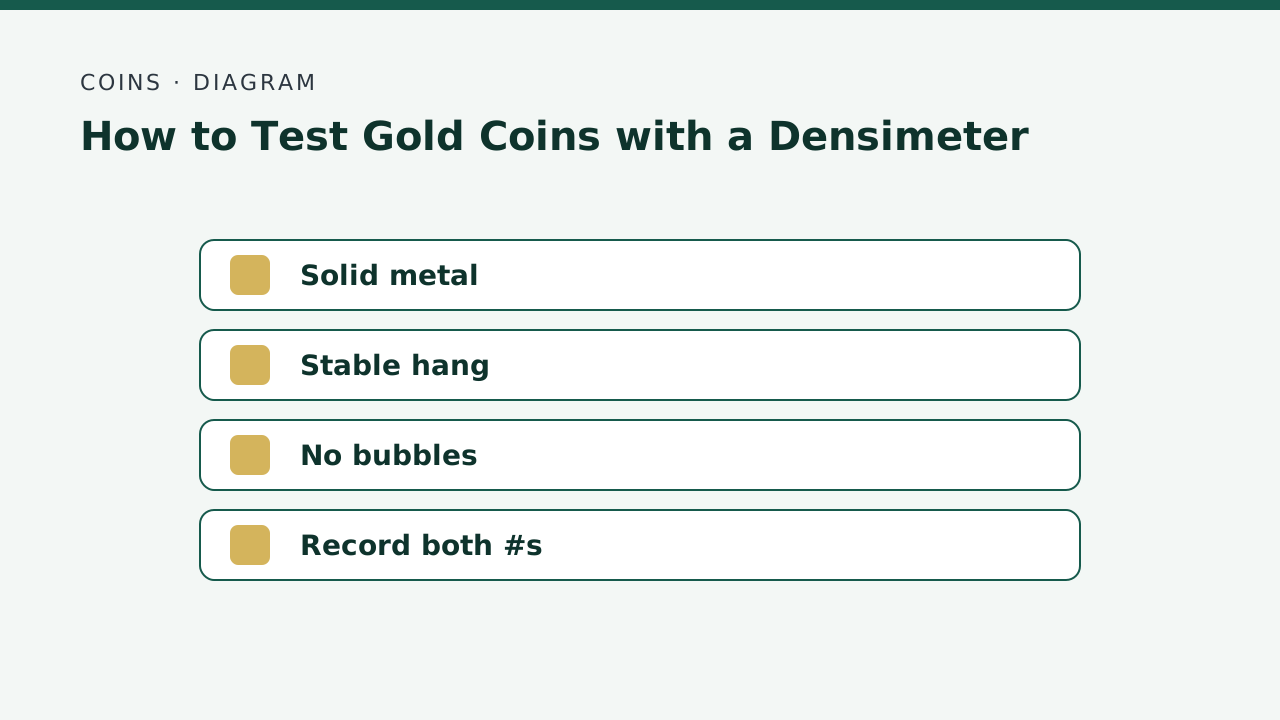
Check tank clearance first
A 1 oz coin is about 32 to 41 mm across. Confirm it sits freely in the basket without touching walls before you trust any reading.
Know the target
Look up the expected alloy density for the coin type before testing, so a surprise result is obvious at a glance.
Protect numismatic value
Do not wet proof, toned, or slabbed coins. A water spot can cost more than the density screen is worth.
Escalate on tickets
Set a dollar threshold above which every coin gets XRF, a conductivity check, or a second method, whatever density says.
Coin intake workflow at the tank
Begin by confirming what the coin claims to be, then pull its published weight and fineness. Weigh it dry first and compare against the known mass; a gold coin should be within a few hundredths of a gram on a calibrated scale, and a clear mismatch is already a red flag before water enters the picture. Handle by the edges with clean gloves or soft tongs, because fingerprints on a bullion coin affect resale even if they do not affect density. Lower the coin onto the basket flat, not leaning, and tilt briefly as it enters so air escapes from the edge reeding and relief. Edge reeding and fine design detail trap more air than the field of the coin. Watch for bubbles along the rim, swirl, tap, and wait for a stable value. Take the reading twice with a re-dip between to confirm repeatability within about 0.05 g/cm³.
Check the tank clearance before the first coin of the day. Large flat coins, especially one-ounce pieces and the bigger crowns, can wedge against the sides of a small basket or hang at a tilt that traps air under the rim. Do a dry fit with a similar-sized dummy piece, and confirm that the basket sits at the same depth with and without a coin on it. If the coin touches the wall at any point, the reading will wander, and the right answer is a larger basket or a different machine rather than a clever hang. Keep coins in their capsules only for storage; always remove them for the test.
- Match dry weight to published mass before using water.
- Edge reeding and relief hold bubbles; tilt and tap.
- Dry the coin fully with a soft cloth or air puff afterward.
Why density clears some fakes and misses others
Density catches the cheap counterfeits: gold-plated copper, brass, or silver blanks sit between 8 and 10.5 g/cm³, nowhere near a gold coin. Those fail loudly and fast, and a densimeter is excellent at catching them. The trouble starts with tungsten. Tungsten is about 19.25 g/cm³ against pure gold at about 19.32, a difference of less than half a percent, which is smaller than the noise on a coin-sized sample in a shop tank. A tungsten core with a thick gold layer can therefore pass a density screen on a 24K coin, and it can pass a surface XRF test too because XRF only reads the outer layer. For high-value coins you need something that sees through the metal: ultrasonic thickness, electrical conductivity testing, or a drill-and-assay on suspect samples. Treat density as the fast gate that removes the obvious problems, and treat the passes above your threshold as unfinished business.
It helps to think about which fakes each method catches and to chart them for the desk. Density catches plated base metals and many alloy substitutions. Magnetism catches steel cores. Dimension checks against mint specifications catch many cast fakes, since a counterfeit of the right weight and a different metal usually has the wrong thickness. Conductivity and ultrasonic testing catch tungsten cores. A coin that passes every one of these is far more likely genuine, but even then a premium-priced numismatic piece deserves provenance checking and, for expensive lots, a trusted grading service rather than a shop-floor test.
Common gold coins and expected densities
Use the table below as a quick reference. Densities are alloy-based estimates assuming ideal mixing and solid construction. Coins from different mints within the same fineness class can differ slightly because of copper and silver proportions, so a reading within about 0.3 g/cm³ of the target is consistent. A reading well outside the target needs a second method before you pay a bullion premium. Log the coin type, dry weight, density, and your decision on the ticket, so that if a coin is later challenged you can show exactly what the first pass saw and which second method followed it.
| Coin | Weight | Fineness | Approx. density (g/cm³) |
|---|---|---|---|
| American Gold Eagle (1 oz) | 33.93 g | 91.67% (22K) | 17.7 |
| Krugerrand (1 oz) | 33.93 g | 91.67% (22K) | 17.6 |
| Canadian Maple Leaf (1 oz) | 31.10 g | 99.99% | 19.3 |
| American Buffalo (1 oz) | 31.10 g | 99.99% | 19.3 |
| British Sovereign | 7.98 g | 91.67% (22K) | 17.6 |
| Mexican 50 Pesos | 41.67 g | 90% | 17.3 |
| US $20 Double Eagle | 33.44 g | 90% | 17.3 |
Recommended densimeters for this workflow
| Product | Best for | Price tier | Editor view | Amazon |
|---|---|---|---|---|
| MDJ-1200K class Gold Densimeter (1200 g) | Coin desks and buyers who see heavy chains or small bars | Value | Editor assessment: Strong | Check Latest Price → |
| RODIETO 600 g Gold Purity Densimeter | Pawn and mixed jewelry intake with heavier solid chains | Value | Editor assessment: Strong | Check Latest Price → |
| Alfa Mirage GK-300 | Jewelry counters buying solid gold under ~250 g | Premium | Editor assessment: Excellent | Check Latest Price → |
Best for Heavy Chains & Coin Desks
MDJ-1200K class Gold Densimeter (1200 g)
- Best forCoin desks and buyers who see heavy chains or small bars
- Price tierValue
- Editor viewEditor assessment: Strong
Best Value / Best for Pawn Capacity
RODIETO 600 g Gold Purity Densimeter
- Best forPawn and mixed jewelry intake with heavier solid chains
- Price tierValue
- Editor viewEditor assessment: Strong
Best Overall for Jewelry Desks
Alfa Mirage GK-300
- Best forJewelry counters buying solid gold under ~250 g
- Price tierPremium
- Editor viewEditor assessment: Excellent
Best for Heavy Chains & Coin Desks
MDJ-1200K class Gold Densimeter (1200 g)

Key takeaways
- 1200 g headroom for heavy chains and small bars
- First-pass tool—not a tungsten-bar closer
- Check tank clearance photos before you buy
Coin desks and buyers who see heavy chains or small bars
Everything you buy is under ~200 g
Quick snapshot
Pros
- 1200 g headroom for heavy solid pieces
- Shop-class 0.001 density resolution
- Common Amazon option for bullion-adjacent buyers
- Often printer-ready for intake records
Cons
- Bulkier and unnecessary for light jewelry-only shops
- Tank clearance can still fail large flat coins—check photos
- Density will not catch every tungsten-filled bar
- Generic branding; verify seller and accessories
Why we picked it
Why it earns the badge
We recommend the MDJ-1200K class when capacity—not brand prestige—is the bottleneck. Coin desks and heavy-chain buyers outgrow 600 g more often than they outgrow 0.001 density resolution. This pick is about headroom and daily workflow: weigh heavy solid pieces without maxing the load cell, run a shop-class density/purity screen, and keep a first-pass number on the ticket before you escalate expensive lots.
Who it is ideal for
Ideal for coin and bullion-adjacent desks, pawn overflow days with thick solid chains, and buyers who occasionally see small bars or stacked solid scrap that would crush a 300 g jewelry densimeter. Many listings in this class also mention printer compatibility, which helps managers who want a paper trail of the screen during customer disputes—as long as everyone understands a slip is not a fire assay certificate.
Who should skip it
Skip it if your solid jewelry stays light (rings and small bracelets under ~200 g). You will park a larger footprint on the counter for no operational gain, and a 300 g premium jewelry unit or a clean 600 g kit will feel less intrusive. Also skip densimetry alone if your main fear is tungsten-filled bars; density of tungsten is too close to high-karat gold for Archimedes to be the closing argument. Write an XRF or assay threshold for those tickets before the machine arrives.
What real buyers get wrong
Tank geometry still matters at 1200 g. Large flat coins or oddly shaped pieces can fail clearance even when the weight is within capacity—check listing photos of the tank and hanger, not just the gram number. Low-star themes in heavy-capacity Amazon densimeter kits mirror the rest of the category: missing accessories, confusing multi-capacity titles, and buyers who expected densimetry to replace every other authenticity tool. Buy the 1200 g class for headroom, confirm the SKU, train solid-sample discipline, and escalate high tickets. That is how coin desks get value from this machine without overclaiming what density can prove.
Key specs → desk benefits
1200 g capacity
Handles heavy solid chains and many small bars without maxing the load cell.
0.001 g/cm³ density display
Gives coin desks a repeatable first-pass number before escalating expensive pieces.
Best Value / Best for Pawn Capacity
RODIETO 600 g Gold Purity Densimeter
Key takeaways
- 600 g headroom for pawn-weight solid chains
- Shop-class 0.001 density without lab pricing
- Confirm seller, accessories, and exact capacity
Pawn and mixed jewelry intake with heavier solid chains
You need Japan-brand prestige more than usable capacity
Quick snapshot
Pros
- 600 g headroom covers most solid chain intake
- 0.001 g/cm³ density resolution is the shop-class sweet spot
- Karat / purity / density in one workflow
- Usually ships as a complete tank + hanger kit
Cons
- Generic brand—seller quality and support vary
- Listing titles can be noisy; you must confirm exact capacity
- Not a tungsten-proof bar tester on its own
- Lower brand recognition if ownership wants “made in Japan” optics
Why we picked it
Why it earns the badge
RODIETO’s 600 g class is our best value pick because capacity is the feature that actually saves pawn and mixed jewelry desks from buying twice. A beautiful 300 g branded unit that cannot weigh your heaviest regular chain is a failed purchase—no matter how clean the karat UI looks in the product photos. This kit targets the real workflow: solid scrap, solid chains, fast karat/density/purity screen, and a complete tank + hanger setup so you are not hunting accessories after the box arrives.
Who it is ideal for
Ideal for pawn shops, mixed jewelry buyers, and scrap desks where solid intake regularly lands between 200 g and 500 g. The 0.001 g/cm³ density resolution is the shop-class sweet spot: fine enough for solid karat banding without paying lab-SKU prices. Managers also get a second number (density or purity %) when karat mode looks off, which helps when a second staffer re-checks a disputed piece.
Who should skip it
Skip it if brand prestige is a boardroom requirement—“made in Japan” optics matter in some retail ownership conversations—or if you only ever buy light rings under ~150 g. In that lighter jewelry-only case, a 300 g premium unit may feel cleaner on a glass retail counter and leave more budget for training and distilled-water discipline. Also skip any densimeter as a standalone answer for bullion bars you suspect are tungsten-filled; density alone will not settle that fight.
What real buyers get wrong
Cross-check Amazon seller ratings and the in-box list (scale, tank, hanger, power, any claimed printer) before you checkout. Across generic 600 g densimeter listings, the honest low-star complaints cluster around missing English instructions, accessories that were pictured but not shipped, confusing multi-SKU titles, and buyers who tested hollow or gem-set jewelry then blamed the machine. Those are avoidable with a pre-purchase checklist: confirm capacity on the live listing, screenshot the accessory list, decline hollow/gem-set pieces at intake, and treat the result as a first pass. Do that, and a value 600 g kit like this becomes the workhorse most pawn desks actually need.
Key specs → desk benefits
600 g capacity
Fewer “piece won’t fit” moments on pawn days when solid chains run heavy.
0.001 g/cm³ density resolution
Fine enough for solid scrap karat banding without paying lab-SKU prices.
Karat + purity + density display
Managers can spot-check a second number (density) when karat mode looks off.
Best Overall for Jewelry Desks
Alfa Mirage GK-300
Key takeaways
- Best when solid jewelry stays under ~250 g
- Karat language staff can explain to customers
- Skip if heavy chains already crowd 300 g
Jewelry counters buying solid gold under ~250 g
You regularly buy heavy chains or bars over 300 g
Quick snapshot
Pros
- Karat modes built for gold buying—not a generic lab densimeter UI
- Japan-made brand that shop owners recognize for warranty optics
- Doubles as a gram scale so trade-ins stay on one footprint
- Non-destructive first pass—no acid stains on retail-ready pieces
Cons
- 300 g ceiling fails many pawn-weight solid chains
- Premium price vs generic 600 g Amazon kits
- Still cannot test hollow or gem-set jewelry (physics limit)
- Some buyers complain about learning the water-hang workflow on day one
Why we picked it
Why it earns the badge
We picked the Alfa Mirage GK-300 as the best overall starter for jewelry stores because it is built around karat language, not just a bare density number. On a retail counter, that matters more than most buyers admit on day one. A salesperson can take a solid trade-in, run the air weight and water weight, and talk in K14 / K18 terms the customer already understands—without translating a raw density chart mid-conversation. The Japan-made positioning also helps when an owner asks why you are not buying the cheapest no-name kit on Amazon. Warranty optics and brand familiarity reduce pushback from partners who have seen too many generic electronics fail after a few busy seasons.
Who it is ideal for
This machine is ideal if your solid intake mostly stays under about 250 g: rings, solid bracelets, light scrap lots, and estate pieces that are clearly solid metal. Treat the 300 g ceiling as a hard workflow limit, not a marketing number. If your desk routinely sees thick Cuban chains, stacked scrap bags, or solid pieces that regularly flirt with 280–300 g, capacity—not brand prestige—should win, and you should move to a 600 g shop densimeter before you outgrow the GK-300 mid-purchase.
Who should skip it
Who should skip it: pawn shops with heavy-chain days, coin desks handling bars, budget-first buyers who only need a rough karat band once a week, and anyone who thinks a densimeter will replace acid or XRF for hollow or gem-set goods. Manufacturer guidance is blunt on the physics limits: hollow jewelry, stone-set pieces, and metals with density very close to gold (including tungsten cores in bars) are outside the trustworthy zone. Those are not “bugs” in the GK-300—they are limits of Archimedes testing itself.
What real buyers get wrong
When you dig past star ratings on Amazon-style densimeter listings, the recurring 1-to-3 star themes are rarely “karat mode is fake.” They are operator and expectation problems: air bubbles clinging to textured scrap, the sample touching the tank wall, testing hollow electroformed jewelry that returns falsely low density, missing English manuals on generic kits, and buyers who expected an assay certificate instead of a first-pass screen. Train solid-sample rules on day one, keep distilled water and a soft brush at the tank, and use a written threshold for when density results escalate to XRF. Done that way, the GK-300 becomes a reliable buyer aid on a jewelry desk rather than a mysterious black box that staff avoid after one awkward customer conversation.
Key specs → desk benefits
300 g capacity / 0.01 g weight resolution
Stable enough for solid rings and most bracelets, with gram-scale precision that keeps scrap payouts honest.
K9–K24 karat + purity % modes
Staff can explain a karat band to a customer in one sentence instead of translating raw density charts.
Densimeter + scale in one unit
You avoid buying a separate jewelry scale for intake weighing on the same counter.
Buying decision
A 1200 g class densimeter gives coin and bullion-adjacent desks capacity to spare. Confirm the tank dimensions on the live listing against the largest coin you buy.
FAQ
Can a densimeter prove a bullion coin is real?
It can prove many fakes are fake, but it cannot prove a coin is genuine, because tungsten-core coins match gold density almost exactly.
Should I test coins in their capsules?
No. Remove the coin from the capsule only if it is not slabbed or numismatic, and never submerge a slabbed coin.
Do large coins fit in the tank?
Most 1 oz coins fit, but 50 peso and larger formats can be tight. Check tank and hanger clearance on the exact kit before buying.