A densimeter that drifted last Tuesday has been quietly mispricing every trade-in since.
This is for pawn managers, jewelry desk leads, and anyone running a densimeter as a daily buying tool. Calibration cadence is where most shops either over-spend time or ignore the problem entirely, so we lay out a practical schedule tied to how the load cell actually drifts.
- The load cell inside a densimeter is a strain-gauge sensor; temperature swings, shocks, and bench moves shift its zero and span.
- A calibration weight near two-thirds of capacity checks span better than a tiny weight near zero.
- A daily check piece with a logged density is the fastest drift detector most shops will ever use.
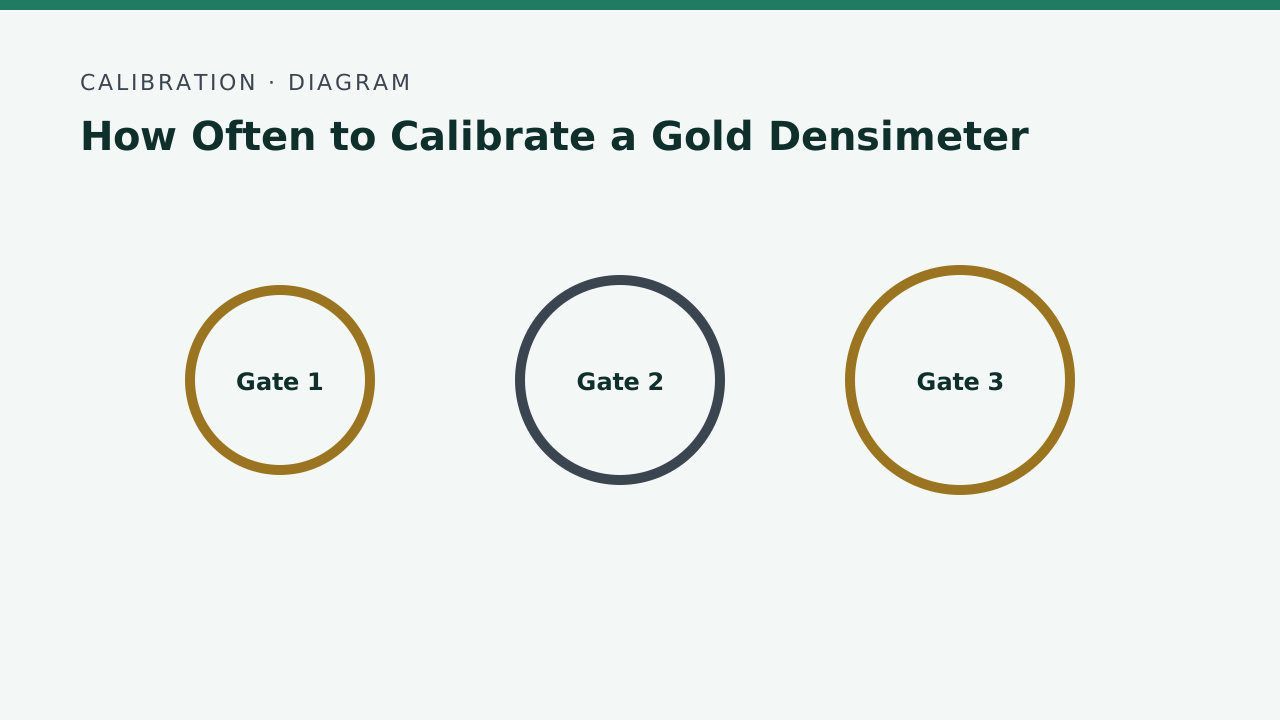
Tie cadence to events
Recalibrate after any move, bump, power loss, or tank change, not only on a calendar schedule.
Pick a weight near your work
If you typically weigh 20 to 200 g solids, a reference weight in the 100 to 200 g range checks the zone where your tickets actually live.
Log every check
A one-line log with date, weight, and reading shows slow drift that a single pass or fail never reveals.
Use certified weights
Cheap uncertified weights can be off by more than the error you are chasing. Buy a class-rated weight and keep it in its case.
Why densimeters drift and what to watch for
Densimeters use load cells that flex under weight. Over weeks the zero point wanders with room temperature, humidity, and mechanical stress. A unit that leaves a warm shipping truck and lands on a cold bench will not read the same as it did a week later. Vibration from nearby equipment, a tilted countertop, or a heavy object dropped on the pan all shift calibration in ways you will not see on the display. Treat any unexplained change as drift until proven otherwise, and log it with the date so you can spot patterns tied to weather, bench moves, or particular staff members who handle the machine differently.
Drift shows up as a slow shift in the weight of a known object or as inconsistent karat results on pieces you already know. If your check weight reads 100.00 g on Monday and 100.04 g by Friday, that is small in absolute terms, but because density depends on a difference of two readings, small span errors amplify, especially on small samples. Catching drift when it is 0.02 g is much cheaper than discovering it after a month of tickets.
A cadence that fits a busy counter
For a shop with daily intake, start each day with a thirty-second zero and check-weight verification. Weekly, run a full calibration routine per the manufacturer manual using a certified weight. After any relocation, power cycle, or accident, recalibrate before the first ticket. For light-use desks that test a few pieces a week, calibrate monthly and always before a high-value lot. Add a house check piece: a solid item of known density, ideally verified once by XRF or assay, that you run at open and close. Record the density to the second decimal. If it wanders by more than about 0.05 g/cm³ from your baseline, stop and investigate the tank, bubbles, temperature, and calibration before the next customer. This is a shop-set tolerance, not a manufacturer spec, so tune it to your own repeatability after a week of data.
Calibration is also a documentation task. Keep a single sheet next to the machine with the date, the check weight, the displayed value, the operator's initials, and the room temperature. After a month the sheet shows the real drift rate for your bench, and you can move from a guessed schedule to a measured one. Shops that keep this log find that most drift events cluster around bench moves, power cycles, and seasonal temperature swings, which lets them add targeted checks at those moments instead of calibrating every day out of caution and wasting staff time during busy hours.
- Daily: zero check, check-weight reading, check-piece density.
- Weekly: full calibration with a certified weight.
- Event-driven: after moves, shocks, power loss, or tank refill.
Calibration schedule by shop type
Not every desk needs the same rhythm. The table below gives a starting schedule based on how many tests you run and how much ticket value rides on each one. Tighten it if you see drift in your own logs, and relax it only after a quarter of stable data. Heavier machines in the 600 g and 1200 g classes benefit most from a check weight in the 200 to 500 g region. Whatever schedule you choose, write it down and assign it to a named person. Unowned calibration tasks are the ones that quietly stop happening, usually right before a disputed ticket exposes the gap.
When a calibration check fails, resist the urge to adjust and carry on. First rerun the check after confirming the machine is level, the pan is clean, and no draft or vibration source is nearby. If the error persists, run the full calibration routine from the manual with a certified weight, then retest the house check piece and a few retained samples from earlier tickets. If those earlier tickets now read differently, flag them for review, because the drift may have affected purchases made since the last good check. Writing this response down as a short procedure keeps the reaction calm and consistent when pressure is high.
| Shop profile | Daily check | Full calibration | Suggested weight |
|---|---|---|---|
| Jewelry counter, 5–10 tests/week | Zero + check piece | Monthly | 100 g |
| Pawn shop, daily heavy intake | Zero + check weight + piece | Weekly | 200 g (600 g unit) |
| Coin / bullion desk | Zero + check weight | Weekly + before big lots | 500 g (1200 g unit) |
| Scrap buyer, field use | Zero + check weight | Every site move | 100 to 200 g |
Most calibration problems are process problems. A certified weight, a log sheet, and a house check piece cost less than a single bad payout.
FAQ
Can I calibrate with a coin or a piece of jewelry?
No. Use a class-rated calibration weight. Coins and jewelry have uncertain true mass and are not traceable references.
What if my reading is off by 0.02 g after calibration?
That is typically within the resolution of a 0.01 g class unit. Check bubbles, air drafts, and bench level before chasing it further.
Do I need to recalibrate when I change the water?
You should re-zero and verify with the check weight after refilling the tank, because a different water level or temperature can shift the reading.