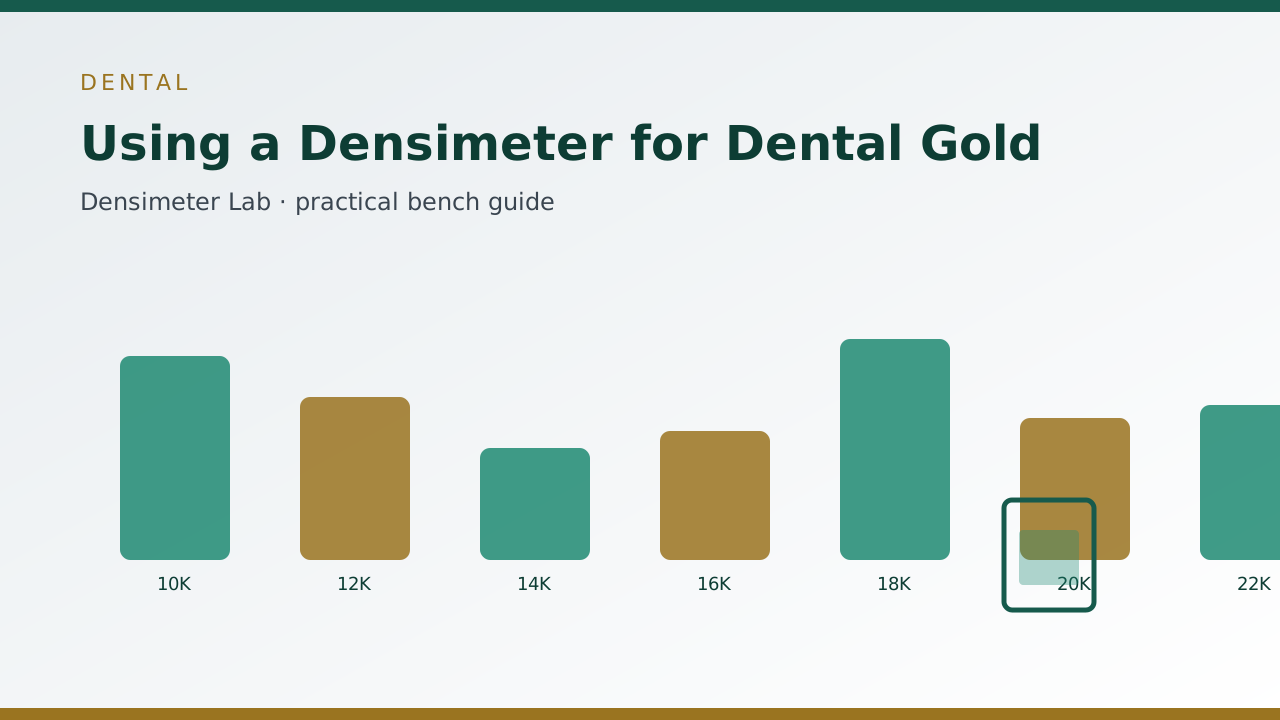
Dental scrap looks like gold but is often a platinum-palladium cocktail, and the karat chart will lie about it.
Small refiners, estate buyers, and scrap desks regularly receive crowns, bridges, and dental scrap bags. Dental alloys follow their own composition tables, and many contain palladium, platinum, or silver in ways that break normal karat conversions. A densimeter can still be useful as a sorting step if you read the number as density, not karat.
- Dental alloys range from about 10 to over 18 g/cm³ depending on the gold, platinum, palladium, and silver content.
- Porcelain-fused crowns contain ceramic and are not solid metal, so they will not give a reliable bulk density.
- A density reading on dental scrap should be matched to a composition table, not converted to karat.
Density, not karat mode
Switch to raw density and compare against alloy data rather than trusting the karat display.
Ceramic and tooth exclusion
Remove porcelain, cement, and tooth fragments before weighing.
Hygiene and safety
Treat dental scrap as a biohazard and clean it before the tank touches it.
Sorting vs valuing
Use density to sort lots, then value by assay or refiner return.
Why dental alloys break the karat chart
Jewelry karat tables assume a gold-copper-silver alloy. Dental restorative alloys are engineered for biocompatibility, thermal expansion, and corrosion resistance, so they include palladium, platinum, indium, tin, and sometimes iridium for grain refinement. A high-noble ceramic alloy might be 50 to 55 percent gold with palladium, while a palladium-silver alloy may contain no gold at all and sit near 10.7 g/cm³, which looks suspiciously like 10K gold on a jewelry display. In dental work the label on the invoice, not the colour of the metal, is the most useful starting clue about what you are holding.
Traditional cast gold crowns, often described by dentists as Type III or Type IV, usually contain about 60 to 75 percent gold with platinum group metals and copper, and density often falls between 15 and 17. A display in karat mode might label that as 18K to 20K, but the gold content could be well below that. Treat the karat display as a placeholder and make your decision from the density and a composition reference or sample assay. Dental suppliers publish composition and density data sheets for their alloys, and matching a measured density to those sheets is far more defensible than converting to karat.
- Gold-palladium ceramic alloys: densities roughly 13.5 to 14.5
- Gold-platinum-palladium: often above 17
- Silver-palladium: near 10.5 to 11, mimics low-karat gold
Preparing a dental lot for the tank
Dental scrap arrives dirty. Soak in a disinfecting solution per your local handling rules, rinse, and dry. Remove tooth structure, porcelain veneer, cement, and any solder or screw fragments. If you cannot separate the ceramic from the metal, set that piece aside because the ceramic is a lower-density volume that distorts the reading. Wear gloves, work in a ventilated space, and keep a dedicated brush for dental batches so cross-contamination with jewelry customers never becomes an issue. Keep the sorted pieces on a clean tray so nothing is lost between the soak and the scale.
Weigh individual crowns and copings only if they weigh above the minimum sample weight for your machine; many crowns are only 1 to 4 g, and single weighings are noisy. Pool similar-looking pieces and test them as a lot, using the lot logic from scrap testing. Run triplicates and record density to the second decimal. Take the cleaned water out of service after dental batches, because organic residue and surfactants leave a film that traps bubbles. Finally, log the lot weight and the final melt weight, because dental scrap often loses more mass to cement and porcelain than sellers expect, and that gap is where disputes start.
Using density alongside other checks
Density narrows the field but does not name the alloy. A reading near 17.5 suggests a high-platinum gold alloy; near 14, a gold-palladium; near 10.7, silver-palladium. Combine that with colour: yellow tends to mean a higher gold fraction, while a whitish tint suggests palladium or platinum. XRF is the preferred next step because it reports elemental percentages directly, and a fire assay is the final word for refiner settlement. Treat density as a sorting key that decides which refiner sample or XRF run each lot gets, not as the final valuation.
Also be realistic about what density will not tell you. Mixed lots of different alloys will give an average that matches no real alloy, and hollow crowns or those with core build-up resin will read low. The sensible commercial approach is to sort by density and colour, then send a representative melt sample to a refiner and pay on that result. Always make clear to the seller that your screen is preliminary and that settlement follows the refiner's number, which keeps expectations honest from the start.
| Dental alloy family | Approx. density (g/cm³) | Likely read-through |
|---|---|---|
| Type III/IV yellow gold | 15 to 17 | Looks like 18K to 20K, gold content varies |
| Gold-palladium ceramic | 13.5 to 14.5 | Looks like 14K to 16K |
| Gold-platinum-palladium ceramic | 17 to 18.5 | Looks like 20K or above, often overstated |
| Silver-palladium | 10.5 to 11 | Looks like 10K but contains no gold |
Recommended densimeters for this workflow
| Product | Best for | Price tier | Editor view | Amazon |
|---|---|---|---|---|
| Alfa Mirage GKS-300 | Mixed gold + platinum desks that need finer purity readouts | Premium | Editor assessment: Strong | Check Latest Price → |
| RODIETO 600 g Gold Purity Densimeter | Pawn and mixed jewelry intake with heavier solid chains | Value | Editor assessment: Strong | Check Latest Price → |
Best for Platinum / Finer Purity
Alfa Mirage GKS-300
- Best forMixed gold + platinum desks that need finer purity readouts
- Price tierPremium
- Editor viewEditor assessment: Strong
Best Value / Best for Pawn Capacity
RODIETO 600 g Gold Purity Densimeter
- Best forPawn and mixed jewelry intake with heavier solid chains
- Price tierValue
- Editor viewEditor assessment: Strong
Best for Platinum / Finer Purity
Alfa Mirage GKS-300
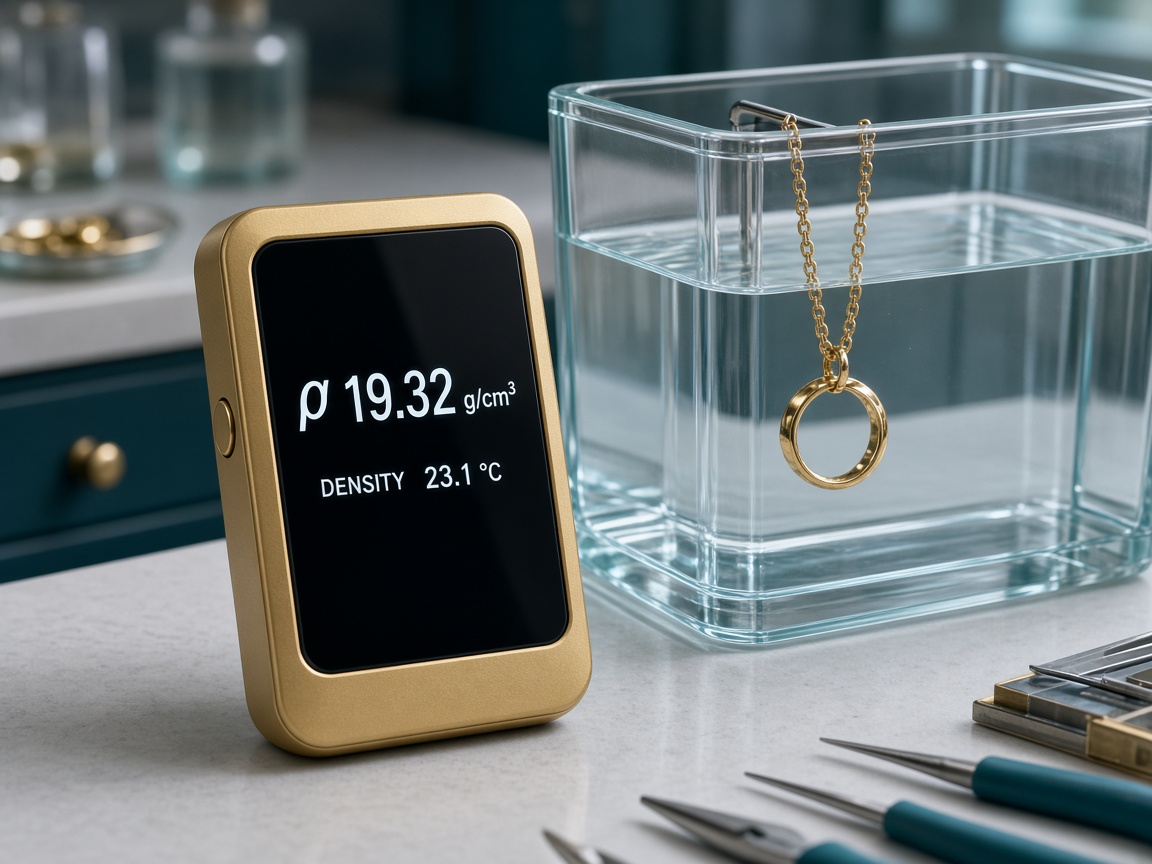
Key takeaways
- Upgrade for platinum + finer purity—not more capacity
- Ideal after staff already know air/water workflow
- Wrong pick if heavy chains are the real bottleneck
Mixed gold + platinum desks that need finer purity readouts
You only need basic 10K/14K banding or need >300 g capacity
Quick snapshot
Pros
- Finer weighing supports tighter purity display than base GK-300
- Platinum tables help mixed precious-metal counters
- Lower minimum sample weight on the GKS class
- Same non-destructive solid-metal workflow jewelers already trust
Cons
- Same 300 g ceiling—no capacity upgrade over GK-300
- Costs more; overkill if you only screen broad karat bands
- Still blind on hollow / gem-set constructions
- Buyers who needed grams of capacity sometimes regret not buying 600 g instead
Why we picked it
Why it earns the badge
The GKS-300 is our pick when a jewelry desk already understands densimetry and needs finer purity—especially with platinum in the mix. Paying more for another 300 g machine only makes sense if resolution and metal tables are the bottleneck, not capacity. The GKS class is aimed at buyers who already trust the air/water workflow and want a tighter purity display plus platinum tables so mixed precious desks do not bounce between instruments mid-intake.
Who it is ideal for
Ideal buyer: estate jewelry shops, mixed gold/platinum buyers, counters that quote tighter purity on solid lots, and managers who already trained staff on solid-sample rules. If your real pain is heavy chains or small bars, this is the wrong upgrade path. Buying finer decimals on a 300 g load cell will not fix “piece won’t fit” days. Move to 600 g or 1200 g capacity first, then revisit finer resolution only if disputed near-pure lots justify it.
Who should skip it
Skip it if you are budget-first, still learning the air/water workflow, or only need broad 10K/14K banding for scrap payouts. In those cases the base GK-300—or a clear 600 g value kit—delivers more practical upside per dollar. Also skip it if you mainly handle gem-set fashion jewelry; finer resolution does not fix the mixed-density problem of stones and hollow links.
What real buyers get wrong
Honest buyer sentiment in this category often sounds like disappointment about capacity, not about the decimal places. Reviewers who needed grams of headroom regret spending premium money on another 300 g footprint. Others expect densimetry to settle tungsten-bar disputes and walk away frustrated—density of tungsten is too close to high-karat gold for Archimedes alone. Use the GKS-300 as a sharper first-pass tool for solid gold and platinum desk work, pair high tickets with XRF or assay policy, and you get the upgrade you paid for instead of a more expensive version of the wrong problem.
Key specs → desk benefits
0.001 g weight resolution / finer density class
Helps when you are comparing near-pure pieces or platinum marks where coarse banding feels sloppy.
Gold + platinum purity tables
One bench tool covers more of a mixed precious desk without switching instruments mid-intake.
Best Value / Best for Pawn Capacity
RODIETO 600 g Gold Purity Densimeter
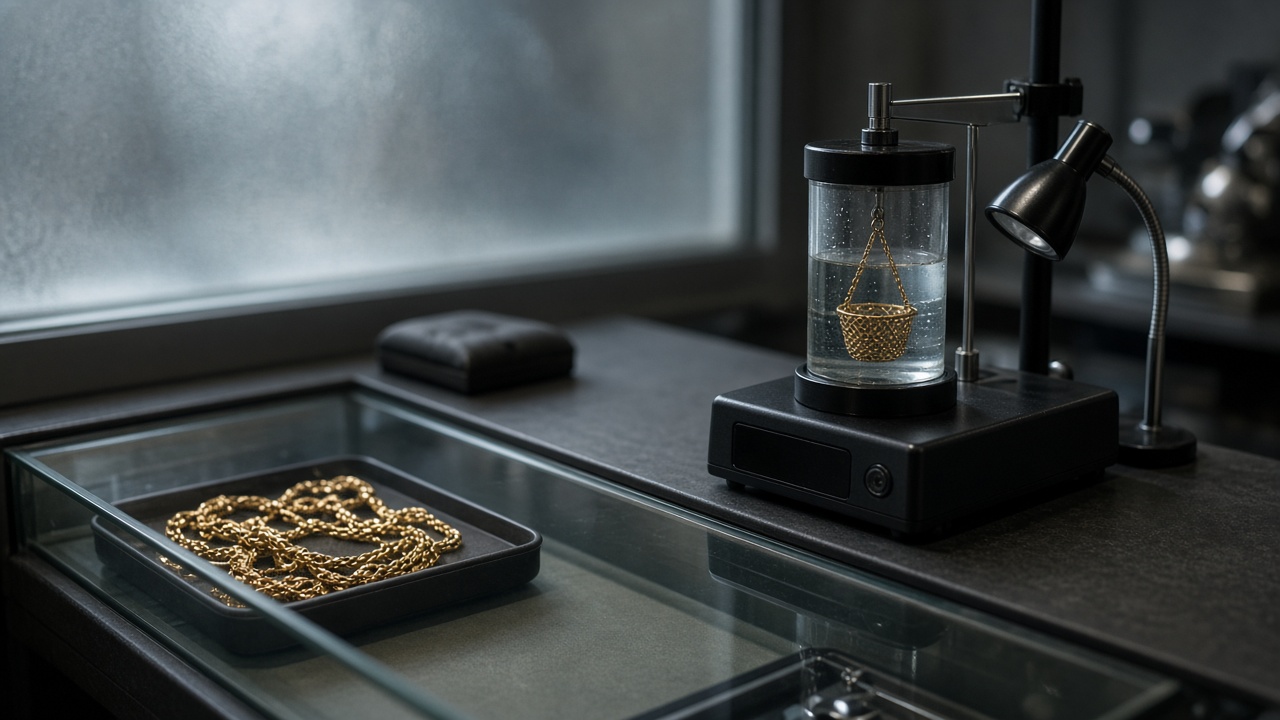
Key takeaways
- 600 g headroom for pawn-weight solid chains
- Shop-class 0.001 density without lab pricing
- Confirm seller, accessories, and exact capacity
Pawn and mixed jewelry intake with heavier solid chains
You need Japan-brand prestige more than usable capacity
Quick snapshot
Pros
- 600 g headroom covers most solid chain intake
- 0.001 g/cm³ density resolution is the shop-class sweet spot
- Karat / purity / density in one workflow
- Usually ships as a complete tank + hanger kit
Cons
- Generic brand—seller quality and support vary
- Listing titles can be noisy; you must confirm exact capacity
- Not a tungsten-proof bar tester on its own
- Lower brand recognition if ownership wants “made in Japan” optics
Why we picked it
Why it earns the badge
RODIETO’s 600 g class is our best value pick because capacity is the feature that actually saves pawn and mixed jewelry desks from buying twice. A beautiful 300 g branded unit that cannot weigh your heaviest regular chain is a failed purchase—no matter how clean the karat UI looks in the product photos. This kit targets the real workflow: solid scrap, solid chains, fast karat/density/purity screen, and a complete tank + hanger setup so you are not hunting accessories after the box arrives.
Who it is ideal for
Ideal for pawn shops, mixed jewelry buyers, and scrap desks where solid intake regularly lands between 200 g and 500 g. The 0.001 g/cm³ density resolution is the shop-class sweet spot: fine enough for solid karat banding without paying lab-SKU prices. Managers also get a second number (density or purity %) when karat mode looks off, which helps when a second staffer re-checks a disputed piece.
Who should skip it
Skip it if brand prestige is a boardroom requirement—“made in Japan” optics matter in some retail ownership conversations—or if you only ever buy light rings under ~150 g. In that lighter jewelry-only case, a 300 g premium unit may feel cleaner on a glass retail counter and leave more budget for training and distilled-water discipline. Also skip any densimeter as a standalone answer for bullion bars you suspect are tungsten-filled; density alone will not settle that fight.
What real buyers get wrong
Cross-check Amazon seller ratings and the in-box list (scale, tank, hanger, power, any claimed printer) before you checkout. Across generic 600 g densimeter listings, the honest low-star complaints cluster around missing English instructions, accessories that were pictured but not shipped, confusing multi-SKU titles, and buyers who tested hollow or gem-set jewelry then blamed the machine. Those are avoidable with a pre-purchase checklist: confirm capacity on the live listing, screenshot the accessory list, decline hollow/gem-set pieces at intake, and treat the result as a first pass. Do that, and a value 600 g kit like this becomes the workhorse most pawn desks actually need.
Key specs → desk benefits
600 g capacity
Fewer “piece won’t fit” moments on pawn days when solid chains run heavy.
0.001 g/cm³ density resolution
Fine enough for solid scrap karat banding without paying lab-SKU prices.
Karat + purity + density display
Managers can spot-check a second number (density) when karat mode looks off.
Buying decision
Dental sorting benefits from the finer weight resolution of the GKS-300 class when sample masses are small.
FAQ
Can I use the karat mode for dental gold?
Not for valuation. Karat tables assume jewelry alloys, so dental alloys with palladium or platinum will be mislabelled.
How big does a dental sample need to be?
Single crowns are often too light for a stable reading. Combine similar pieces into a lot above your machine's minimum sample weight.
Is a densimeter enough to pay for dental scrap?
No. Use it to sort, then pay on XRF or refiner assay results because composition varies widely.