Every gold densimeter is a desktop instrument, and the 'portable' versions people search for are really either travel scale kits or a different tool entirely.
Buyers who travel to estate sales, trade shows, or pop-up counters often ask whether a portable gold densimeter exists. The honest answer is that Archimedes testing needs a stable surface, still water, and a load cell that is not disturbed, so a true handheld density tester does not exist. This guide explains what 'portable' really means in this category, how to set up a temporary bench, and when to carry a different tool instead.
- A densimeter needs a level, vibration-free surface and a tank of still water, so it is effectively a benchtop instrument.
- Handheld devices sold as portable gold testers usually measure electrical conductivity or surface chemistry, not bulk density.
- A small 300 g desktop unit with a travel case is the realistic portable option for off-site buying.
Surface and levelness
The load cell reads weight, so tilt, drafts, and wobbly tables show up directly as reading noise.
Water handling
Carrying water and keeping it still in a car is the hardest part of mobile testing.
Warm-up and settling
Allow time for the machine and water to reach room temperature after transport.
What the device really measures
Check whether a 'portable' product measures density, conductivity, or surface elements.
Why true portability is hard for density testing
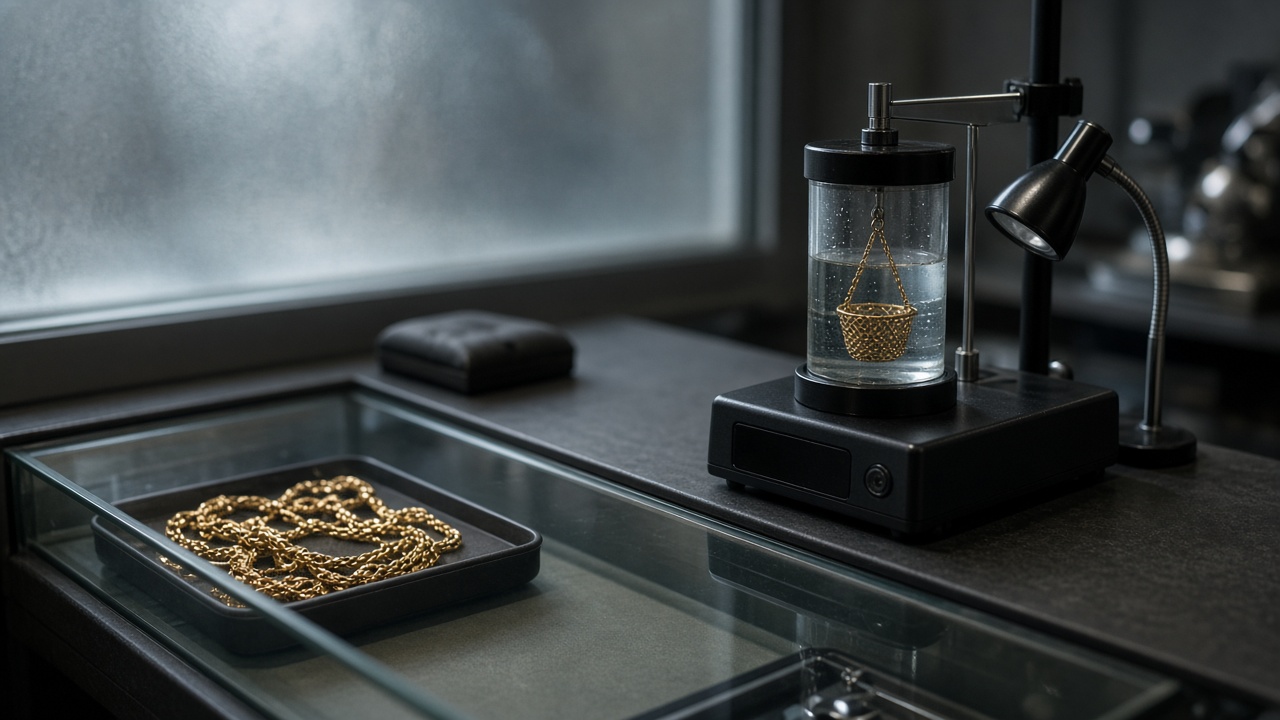
Density testing is weighing, and weighing is sensitive to its environment. The piece hangs in a basket under water while a balance reads fractions of a gram, so a draft, a vibration, or a table that flexes will change the number. Moving a tank full of water also creates ripples and bubbles that take minutes to settle. These constraints are physical, not a design shortcut, which is why every genuine gold densimeter has a tank, a hanger, and a base that must sit level. A pocket-sized device cannot replace that arrangement.
Most products marketed as portable gold testers use a completely different principle. Some measure how a metal conducts electricity at the surface, some use a small X-ray source, and some are acid-style kits in a case. These tools are genuinely portable and have their uses, but they answer a different question than density does. A conductivity probe may be fooled by thin plating, and an acid kit leaves marks. When someone sells a handheld product as a densimeter, check the manual for the actual measurement method before you buy.
Setting up a temporary bench that works
If you must buy off-site, build a repeatable mini bench. Carry the densimeter, a small bottle of distilled water, a soft cloth, and a stable plate or board to put under the tank. Choose a table away from doors, fans, and foot traffic. Level the unit using the feet or a small bubble level, fill the tank, wait ten to fifteen minutes for the water to settle and reach room temperature, then run the calibration weight before the first piece.
Keep the checks short and consistent. Record each result with the date and location so you can spot drift between sites. Bring a second method for high-value or unmarked items, because a temporary bench never matches the stability of your main counter. If conditions are poor, such as outdoor wind or a hot car, decline to test and say why. A sensible refusal is better than a bad number you pay on, and it shows customers that your process is real.
- Pack the tank empty and refill on site with distilled water.
- Allow warm-up and water settling before the first test.
- Run the calibration weight each time you set up in a new location.
Desktop, travel setup, and handheld options compared
The table below separates the three situations people describe as portable, so you can decide which tool belongs in your case and which still belongs on the counter. Only the first two rows give you a bulk density number, and that distinction should drive the purchase.
| Option | Measures density? | Best use |
|---|---|---|
| Desktop densimeter | Yes | Main counter and repeat screening |
| Desktop unit in a travel kit | Yes, with careful setup | Occasional estate or show buying |
| Handheld conductivity probe | No | Quick surface check on small items |
| Handheld XRF analyzer | No | Elemental sorting on site |
Recommended densimeters for this workflow
| Product | Best for | Price tier | Editor view | Amazon |
|---|---|---|---|---|
| Alfa Mirage GK-300 | Jewelry counters buying solid gold under ~250 g | Premium | Editor assessment: Excellent | Check Latest Price → |
| RODIETO 600 g Gold Purity Densimeter | Pawn and mixed jewelry intake with heavier solid chains | Value | Editor assessment: Strong | Check Latest Price → |
Best Overall for Jewelry Desks
Alfa Mirage GK-300
- Best forJewelry counters buying solid gold under ~250 g
- Price tierPremium
- Editor viewEditor assessment: Excellent
Best Value / Best for Pawn Capacity
RODIETO 600 g Gold Purity Densimeter
- Best forPawn and mixed jewelry intake with heavier solid chains
- Price tierValue
- Editor viewEditor assessment: Strong
Best Overall for Jewelry Desks
Alfa Mirage GK-300
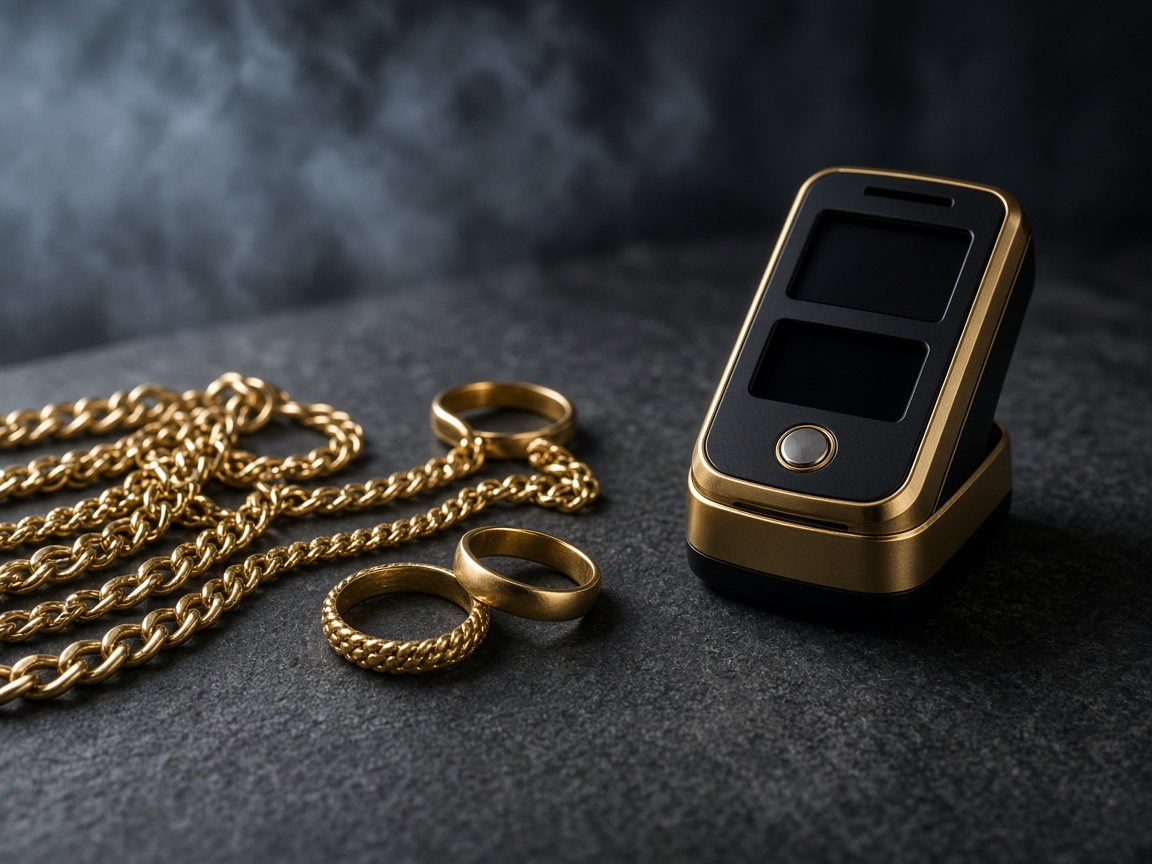
Key takeaways
- Best when solid jewelry stays under ~250 g
- Karat language staff can explain to customers
- Skip if heavy chains already crowd 300 g
Jewelry counters buying solid gold under ~250 g
You regularly buy heavy chains or bars over 300 g
Quick snapshot
Pros
- Karat modes built for gold buying—not a generic lab densimeter UI
- Japan-made brand that shop owners recognize for warranty optics
- Doubles as a gram scale so trade-ins stay on one footprint
- Non-destructive first pass—no acid stains on retail-ready pieces
Cons
- 300 g ceiling fails many pawn-weight solid chains
- Premium price vs generic 600 g Amazon kits
- Still cannot test hollow or gem-set jewelry (physics limit)
- Some buyers complain about learning the water-hang workflow on day one
Why we picked it
Why it earns the badge
We picked the Alfa Mirage GK-300 as the best overall starter for jewelry stores because it is built around karat language, not just a bare density number. On a retail counter, that matters more than most buyers admit on day one. A salesperson can take a solid trade-in, run the air weight and water weight, and talk in K14 / K18 terms the customer already understands—without translating a raw density chart mid-conversation. The Japan-made positioning also helps when an owner asks why you are not buying the cheapest no-name kit on Amazon. Warranty optics and brand familiarity reduce pushback from partners who have seen too many generic electronics fail after a few busy seasons.
Who it is ideal for
This machine is ideal if your solid intake mostly stays under about 250 g: rings, solid bracelets, light scrap lots, and estate pieces that are clearly solid metal. Treat the 300 g ceiling as a hard workflow limit, not a marketing number. If your desk routinely sees thick Cuban chains, stacked scrap bags, or solid pieces that regularly flirt with 280–300 g, capacity—not brand prestige—should win, and you should move to a 600 g shop densimeter before you outgrow the GK-300 mid-purchase.
Who should skip it
Who should skip it: pawn shops with heavy-chain days, coin desks handling bars, budget-first buyers who only need a rough karat band once a week, and anyone who thinks a densimeter will replace acid or XRF for hollow or gem-set goods. Manufacturer guidance is blunt on the physics limits: hollow jewelry, stone-set pieces, and metals with density very close to gold (including tungsten cores in bars) are outside the trustworthy zone. Those are not “bugs” in the GK-300—they are limits of Archimedes testing itself.
What real buyers get wrong
When you dig past star ratings on Amazon-style densimeter listings, the recurring 1-to-3 star themes are rarely “karat mode is fake.” They are operator and expectation problems: air bubbles clinging to textured scrap, the sample touching the tank wall, testing hollow electroformed jewelry that returns falsely low density, missing English manuals on generic kits, and buyers who expected an assay certificate instead of a first-pass screen. Train solid-sample rules on day one, keep distilled water and a soft brush at the tank, and use a written threshold for when density results escalate to XRF. Done that way, the GK-300 becomes a reliable buyer aid on a jewelry desk rather than a mysterious black box that staff avoid after one awkward customer conversation.
Key specs → desk benefits
300 g capacity / 0.01 g weight resolution
Stable enough for solid rings and most bracelets, with gram-scale precision that keeps scrap payouts honest.
K9–K24 karat + purity % modes
Staff can explain a karat band to a customer in one sentence instead of translating raw density charts.
Densimeter + scale in one unit
You avoid buying a separate jewelry scale for intake weighing on the same counter.
Best Value / Best for Pawn Capacity
RODIETO 600 g Gold Purity Densimeter
Key takeaways
- 600 g headroom for pawn-weight solid chains
- Shop-class 0.001 density without lab pricing
- Confirm seller, accessories, and exact capacity
Pawn and mixed jewelry intake with heavier solid chains
You need Japan-brand prestige more than usable capacity
Quick snapshot
Pros
- 600 g headroom covers most solid chain intake
- 0.001 g/cm³ density resolution is the shop-class sweet spot
- Karat / purity / density in one workflow
- Usually ships as a complete tank + hanger kit
Cons
- Generic brand—seller quality and support vary
- Listing titles can be noisy; you must confirm exact capacity
- Not a tungsten-proof bar tester on its own
- Lower brand recognition if ownership wants “made in Japan” optics
Why we picked it
Why it earns the badge
RODIETO’s 600 g class is our best value pick because capacity is the feature that actually saves pawn and mixed jewelry desks from buying twice. A beautiful 300 g branded unit that cannot weigh your heaviest regular chain is a failed purchase—no matter how clean the karat UI looks in the product photos. This kit targets the real workflow: solid scrap, solid chains, fast karat/density/purity screen, and a complete tank + hanger setup so you are not hunting accessories after the box arrives.
Who it is ideal for
Ideal for pawn shops, mixed jewelry buyers, and scrap desks where solid intake regularly lands between 200 g and 500 g. The 0.001 g/cm³ density resolution is the shop-class sweet spot: fine enough for solid karat banding without paying lab-SKU prices. Managers also get a second number (density or purity %) when karat mode looks off, which helps when a second staffer re-checks a disputed piece.
Who should skip it
Skip it if brand prestige is a boardroom requirement—“made in Japan” optics matter in some retail ownership conversations—or if you only ever buy light rings under ~150 g. In that lighter jewelry-only case, a 300 g premium unit may feel cleaner on a glass retail counter and leave more budget for training and distilled-water discipline. Also skip any densimeter as a standalone answer for bullion bars you suspect are tungsten-filled; density alone will not settle that fight.
What real buyers get wrong
Cross-check Amazon seller ratings and the in-box list (scale, tank, hanger, power, any claimed printer) before you checkout. Across generic 600 g densimeter listings, the honest low-star complaints cluster around missing English instructions, accessories that were pictured but not shipped, confusing multi-SKU titles, and buyers who tested hollow or gem-set jewelry then blamed the machine. Those are avoidable with a pre-purchase checklist: confirm capacity on the live listing, screenshot the accessory list, decline hollow/gem-set pieces at intake, and treat the result as a first pass. Do that, and a value 600 g kit like this becomes the workhorse most pawn desks actually need.
Key specs → desk benefits
600 g capacity
Fewer “piece won’t fit” moments on pawn days when solid chains run heavy.
0.001 g/cm³ density resolution
Fine enough for solid scrap karat banding without paying lab-SKU prices.
Karat + purity + density display
Managers can spot-check a second number (density) when karat mode looks off.
Buying decision
Confirm capacity and dimensions on the live listing before you plan for travel.
FAQ
Is there a handheld gold densimeter?
Not for true density testing. Archimedes measurement needs a tank and a stable balance, so handheld products use other methods such as conductivity or X-ray fluorescence.
Can I use my desktop densimeter at a trade show?
Yes with care. Use a level surface away from drafts, let the water settle, run the calibration weight, and decline to test when conditions are poor.
Which is better for travel, the 300 g or 600 g?
The 300 g class is easier to carry but caps your heaviest solid piece. Choose the 600 g class if you expect chains and heavier lots at off-site events.